The question: buckling shingles on a roof installed last November
Sarah from Illinois wrote to Mr. RoofCheck® about buckling shingles on a roof that was installed the previous November.
We just had a roof installed this past November and are having problems with shingles buckling. Getting the contractor to make the repairs has been very difficult, and we ended up having a home inspection performed because the company blamed our ventilation. The report showed no issues with the attic. The shingles were installed on wet underlayment due to rain. The company’s solution is to have a repairman cut off the excess part of the buckled shingles and nail the same shingles back down, without replacing the underlayment or the shingles. Is this an appropriate repair? It just doesn’t sound right to me.
Mr. RoofCheck® responds
Your instinct is worth trusting. Buckling shingles on a roof less than a year old point to a condition underneath the covering, and cutting the tops off the buckles addresses the symptom while leaving whatever caused it in place.
Two causes fit what you have described, and they are not mutually exclusive.
Underlayment that was wet at installation
You noted that the shingles went on over underlayment that had been rained on. Wet felt swells, then wrinkles as it dries, and those wrinkles telegraph straight through the shingles above them. The pattern is usually recognizable: long ridges running roughly parallel across the field, following the courses of the underlayment rather than appearing at random.
Trapped moisture in the deck itself behaves the same way. Sheathing that took on water before the roof was dried in expands, then shrinks as it releases that moisture, and the covering above moves with it.
Manufacturer installation instructions are direct about dry-in conditions. If the underlayment was saturated when the shingles were laid over it, the installation departed from those instructions, and that is a documentable point rather than a matter of opinion.
Fasteners that do not penetrate the sheathing
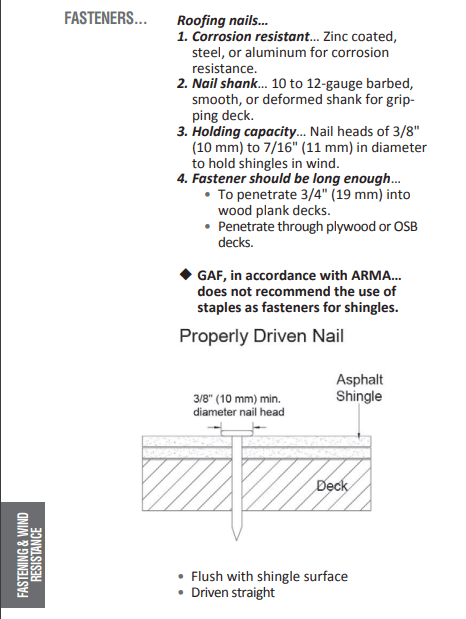
The second common cause is fastener length. When a nail does not pass fully through the roof sheathing, it has nothing holding its point. As the framing and decking expand and contract through seasonal temperature swings, the fastener works its way back up, lifting the shingle with it. On a roof this new, that shows as lifting and buckling across the field rather than at one spot.
An inspector can check this without removing much material. Fastener length, placement in the nail zone, and depth of drive are all measurable, and manufacturer instructions state the requirement for each.
The attic came back clean, which matters
The contractor pointed at ventilation, and your home inspection found no attic issues. Keep that report. It closes off the explanation you were given, and it puts the question back on how the roof was installed.
Why cutting and re-nailing the buckles is a questionable repair
If the underlayment is wrinkled or the fasteners are short, trimming the raised portion of each shingle and nailing it flat does three things. It removes material the shingle needs to shed water and to seal to the course above it. It puts new fasteners through the covering, often outside the nail zone. And it leaves the underlying condition exactly where it was, so the buckling continues to appear elsewhere on the roof.
Shingles are engineered to lie flat and seal as a system. Cut them and you have altered the assembly the manufacturer tested.
What this does to the manufacturer coverage
Manufacturer warranties are conditioned on installation performed to published instructions. If the underlayment condition, the fastener specification, or the field-modification of shingles fall outside those instructions, the manufacturer may treat the coverage as void. That is a conversation to have with the manufacturer directly, in writing, before anyone touches the roof again.
Depending on how widespread the condition is, correcting it properly can mean removing the covering, replacing the underlayment, and reinstalling with correct fasteners. On a roof this young that outcome is difficult to hear, and it is better heard now than after three more seasons of patching.
If you are in this position
- Get an independent inspection. An accredited NRCIA member documents the condition without a stake in the repair, which is what makes the report useful in a dispute.
- Request the product and installation documents. Ask the contractor which shingle line and which underlayment were used, and obtain the manufacturer’s published installation instructions for both.
- Put the ventilation finding in the file. Your home inspection report is evidence.
- Contact the manufacturer yourself. Many run their own field inspection process on installation complaints.
- Do not authorize the cut-and-nail repair until someone independent has established the cause.
A LeakFREE® Roof Inspection Report from an accredited member names the conditions found and what correcting them involves. It is written to be handed to somebody else, which is precisely what you need when a contractor and a homeowner disagree about whose problem this is.
Get an independent look at the roof
Find an accredited NRCIA inspector near you: /member-directory/
LeakFREE®, Forensic ROOF®, Mr. RoofCheck®, InspectionPLUS®, Today’s Inspection… Tomorrow’s Protection®, and Got Leaks?® are registered trademarks of Field Gate FLP, used by permission. RoofGUARD™, ForensicGUARD™, DisasterGUARD™, E3GUARD™, and Think Like a Raindrop™ are trademarks of Field Gate FLP.