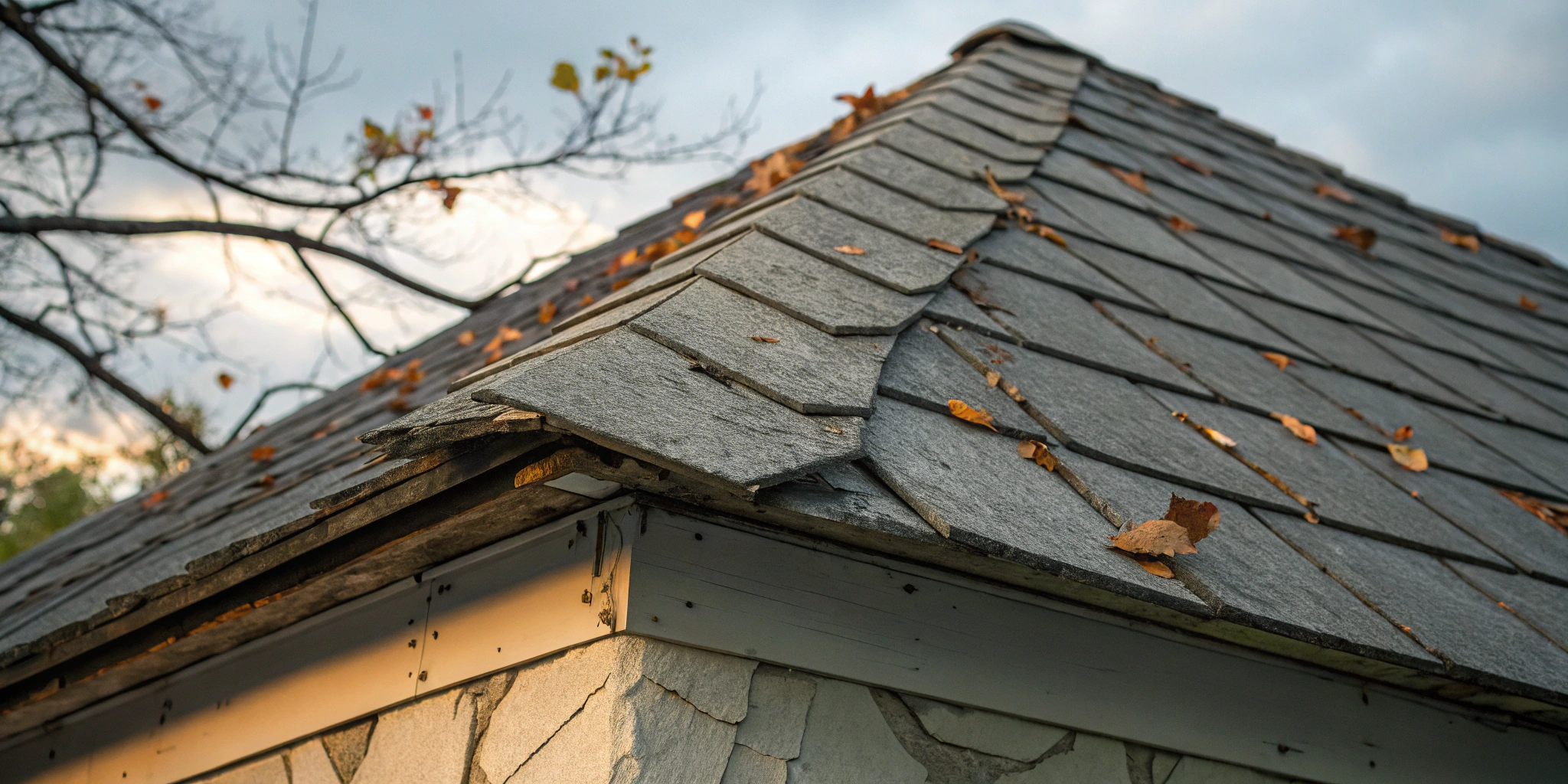
What causes roof material failure
Understanding what causes roof material failure comes down to four things: weather, installation, neglected maintenance, and the age of the material itself. Roofs almost never fail in one night. They fail slowly, in a sequence that leaves evidence at every stage, which is the reason an inspection is worth anything at all.
Here is what each cause looks like, and what it leaves behind.
1. Weather, working slowly
Sun does more damage over a roof’s life than any storm. Ultraviolet exposure breaks down the binders in asphalt, and the daily cycle of expansion and contraction works the material until edges curl and seals loosen. In a hot climate this alone can take years off a covering.
Wind rarely tears a roof off. What it does is break the seal between shingle courses, leaving tabs that look fine from the ground and lift with the next gust. Hail bruises the mat beneath the granules, and the bruise is often invisible until the granules wash away and the exposed asphalt starts to fail.
In cold regions, ice dams form when heat escaping the attic melts snow that refreezes at the colder eave. Water backs up behind the ice and travels under the covering. That failure starts with heat loss into the attic, and the covering ends up as the secondary casualty.
2. Installation, decided on day one
The best material on the market fails early when it goes on wrong. Four errors account for most of it.
- Fastening. Nails driven too deep cut through the shingle. Nails left proud hold the course above off the deck. Angled nails hold nothing at all. All three are invisible from the ground and all three show up as wind loss.
- Flashing. Reused flashing and sealant applied in place of proper metal at a chimney or sidewall is the most common source of a persistent leak. Sealant is a maintenance item. It was never a permanent detail.
- Overlap and sealing. Shingles shed water as a system, and insufficient overlap lets wind-driven rain travel underneath. Installed in cold weather, the adhesive strip may never bond at all.
- Ventilation. Without balanced intake and exhaust, an attic traps heat and moisture. Summer heat cooks the covering from below. Winter condensation rots the deck from the same side.
3. Maintenance that never happened
Clogged gutters back water up under the shingle edge, and that is where eave rot and fascia damage start. Debris on the surface holds moisture against the covering. Small cracks in sealant stay small for exactly as long as nobody ignores them.
On low-slope roofs, blocked drains create standing water, and standing water is heavy. A single inch of water weighs roughly five pounds per square foot. An inch across a large flat roof adds tons of load, the deck deflects, more water collects in the low spot, and the problem accelerates on its own.
4. Age and material defects
Every covering has a service life. Asphalt shingles commonly run 20 to 30 years depending on grade and climate. Tile and metal run longer. Underlayment, flashing and sealant all age on their own schedules, and a roof can reach the end of one component well before the covering is finished.
Manufacturing defects happen too. Adhesive strips that never activate, granule loss well ahead of schedule, delamination. These usually appear across a whole roof plane at once instead of in one spot, which is one of the patterns a trained inspector reads to separate a defect claim from ordinary wear.
Warning signs you can see yourself
From the ground, with binoculars, twice a year and after any serious weather:
- Shingles that are lifted, curled, cracked or gone
- Granules collecting at the bottom of downspouts
- Sagging along a ridge or a soft dip in a roof plane
- Dark streaking, moss or algae holding moisture on the surface
- Damaged or displaced flashing at chimneys, vents and skylights
From inside, in the attic with the lights off: daylight through the deck, damp or matted insulation, staining or mold on the underside of the sheathing. In living space: ceiling stains, discoloration in corners, peeling paint, or a musty smell in one room and nowhere else.
A ceiling stain means water has already passed through the covering, the deck and the insulation. That one is not a wait-and-see item.
What prevents failure
Hire carefully for installation, because that decision sets the ceiling on how long the roof lasts. Keep drainage clear. Watch the attic, since ventilation problems announce themselves there long before they reach the shingles.
Then have the roof inspected on a schedule by someone trained to read it. NRCIA members work the LeakFREE® Check, a five-zone method covering the interior, attic, exterior, perimeter and rooftop. Think Like a Raindrop™ is the principle behind it: water finds every weakness, so the inspection follows where water travels.
There is no federal license for roof inspectors, so the credential is worth checking. RoofGUARD™ produces the NRCIA Certified Roof Inspector (CRI). ForensicGUARD™ produces the Forensic Roof Inspector (FRI), for failures where cause matters to a carrier or a court. Accreditation belongs to the individual, so look the person up before you book.
Where a roof meets the published criteria, an accredited member can issue a LeakFREE® Roof Certification through the InspectionPLUS® platform. It records condition on a date, with a term set by the findings. Across 6,460 member inspections nationwide, more than 66 percent of roofs either qualified for a LeakFREE® certification or could be repaired to qualify. Most failing roofs are caught while they are still repairable, and that is the entire argument for looking early.
Find an accredited NRCIA inspector near you in the member directory.
LeakFREE®, Forensic ROOF®, Mr. RoofCheck®, InspectionPLUS®, Today’s Inspection… Tomorrow’s Protection®, and Got Leaks?® are registered trademarks of Field Gate FLP, used by permission. RoofGUARD™, ForensicGUARD™, DisasterGUARD™, E3GUARD™, and Think Like a Raindrop™ are trademarks of Field Gate FLP.