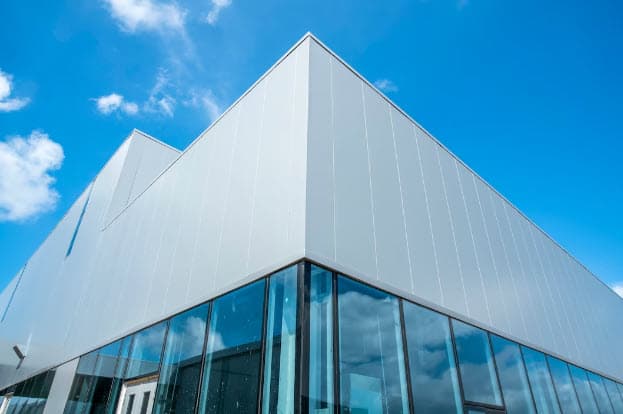
What Is Driving Commercial Roofing Trends
Interior finishes get the attention. The roof decides how long the rest of the building lasts. Water that gets past a commercial roof does not stop at the membrane. It moves into decking, insulation, ceiling tile, inventory and tenant space, and the repair bill lands a long way from where the leak started.
Commercial roofing trends now answer four pressures at once: operating cost, usable square footage, energy performance and fire exposure. Here is what those pressures look like on a real building, and what an owner should ask before approving a roof specification.
Low Maintenance Built Into the Assembly
Upkeep is far easier to control at the design stage than in year seven. Three choices carry most of the weight.
- Insulation and cover board. A continuous cover board over the insulation gives the membrane a firm substrate and improves the air and moisture barrier.
- Deck profile. B deck and N deck carry different loads. Matching the profile to the rooftop equipment, foot traffic and snow load you actually expect prevents deflection and ponding water later.
- UV resistant surfacing. In most climates the sun ages a membrane faster than storms do. Reflective or UV stable surfacing slows that down.
None of this removes the need for scheduled cleaning, drain clearing and hazard removal. It does keep the routine short and the surprises rare.
Rooftops That Earn Their Square Footage
Space is expensive, so owners are putting rooftops to work. Light staging, employee break areas, patio seating, screened equipment yards. A working roof changes the inspection picture, because foot traffic and furniture create wear the original assembly was never asked to take.
Two details matter most. Secure the perimeter with a low profile railing that meets local code without blocking sightlines. Then pick a walking surface, such as rubber or concrete pavers on pedestals, that carries traffic and still lets water reach the drains. Blocked drainage turns a rooftop amenity into a claim faster than anything else on the roof.
Appearance Without Giving Up Performance
Curb appeal is a business asset. Employees and customers form an opinion of a building before they reach the door, and a stained, patched or sagging roofline is part of that opinion.
On low slope roofs, pavers and clean edge metal do most of the visual work. On pitched sections, metal panels and composite tile come in a wide range of profiles, wash easily and hold color well under sun exposure. Ask the manufacturer for the published finish warranty and the tested color retention data rather than accepting a general statement about looks.
Sustainability and the Roof’s Share of the Energy Bill
The United States has set a national target of net zero emissions by 2050, and commercial owners are feeling that in utility budgets and tenant expectations well ahead of the date. Solar is the obvious move. It is one option among several.
- Raise the R value with added insulation and a cover board.
- Specify recyclable materials such as metal where the design allows it.
- Choose surfacing that resists degradation, since air and moisture moving through a failing assembly undoes the insulation you paid for.
One caution on solar. Panels change how a roof gets inspected and repaired. Mounting penetrations, wire runs and racking all become part of the water management system. Have the roof evaluated before the array goes on, not after.
Fire Resistance as a Design Question
Wildfire exposure has widened well past the traditional fire zones, and electrical and equipment fires are a risk in any building. Roof coverings are rated Class A, B or C under ASTM E108 and UL 790, with Class A the highest rating in that scale. Metal, composite and stone pavers are commonly available in Class A assemblies. Ask for the rating of the tested assembly rather than the rating of a single component, because the deck, underlayment and covering are tested together.
Where Inspection Fits in Commercial Roofing Trends
Specifications age. Tenants change. Equipment gets added to the roof, and those new penetrations are rarely flashed as carefully as the original work. A documented multi-zone inspection tells an owner what the roof is doing now instead of what it was designed to do in year one.
NRCIA sets the standard those inspections follow. Accredited members perform a LeakFREE® Check across five zones: interior, attic or plenum, exterior, perimeter and rooftop. The member issues a LeakFREE® Roof Inspection Report, and where the roof meets the published criteria, an accredited member can issue a LeakFREE® Roof Certification generated through InspectionPLUS®. LeakFREE® is our federally registered trademark. Only NRCIA members can issue a LeakFREE® certification.
A certification records the condition of one roof, at one address, on one date, against published criteria. It is not insurance and not a service contract, and it makes no promise about future leaks. What it gives an owner, a lender or a buyer is a dated, documented position rather than an opinion.
Ask for the Condition, Not the Brochure
Every trend above is a decision about how much water, heat and fire the roof is asked to handle. The way to find out whether those decisions are working is to have the roof examined by someone trained to a published standard and required to write down what they found.
Find an accredited inspector in the NRCIA member directory.
LeakFREE®, Forensic ROOF®, Mr. RoofCheck®, InspectionPLUS®, Today’s Inspection… Tomorrow’s Protection®, and Got Leaks?® are registered trademarks of Field Gate FLP, used by permission. RoofGUARD™, ForensicGUARD™, DisasterGUARD™, E3GUARD™, and Think Like a Raindrop™ are trademarks of Field Gate FLP.