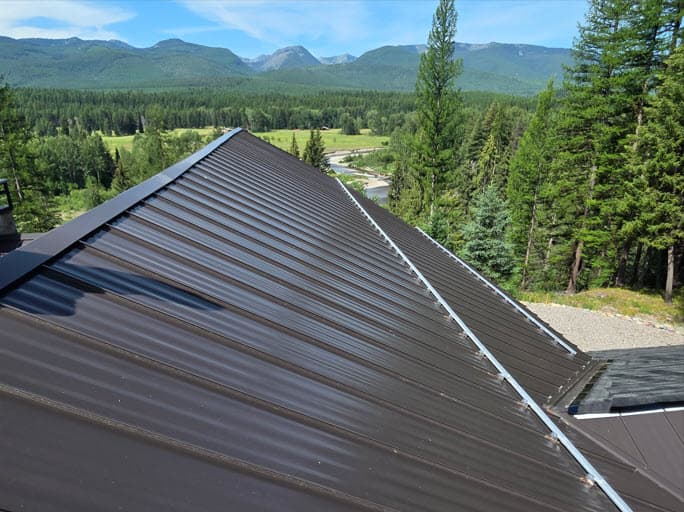
How metal roof systems differ from each other
Metal roofing covers several different assemblies, and they do not perform the same way. Service life, cost, fastening method and appearance all change depending on which metal roof system you choose. Here is what separates the common options, what to check before you sign, and which metal holds up near salt air.
Standing seam
Vertical panels with raised seams that lock together. Fasteners are concealed under the seam, so there is no exposed gasket aging in the sun.
Strengths: service life commonly cited at 40 to 70 years, clean modern appearance, low maintenance, strong performance under high wind and snow load.
Trade offs: higher installed cost, specialized installation, and more rain noise without adequate underlayment and attic insulation.
Metal shingles and tiles
Steel or aluminum formed to imitate shingles, wood shake or slate.
Strengths: traditional appearance, much lighter than real slate or concrete tile, service life commonly 40 to 60 years.
Trade offs: more exposed fasteners depending on the profile, and labor intensive installation around penetrations and valleys.
Corrugated panels
Ribbed or wavy panels, typically installed with exposed fasteners. Long associated with agricultural buildings, now common on rural and industrial style homes.
Strengths: lower cost, light weight, straightforward installation, a strong panel for the money.
Trade offs: exposed fasteners with rubber washers that need periodic attention, a plainer appearance, and a shorter service life commonly given as 20 to 40 years.
Stone coated steel
Steel panels finished with bonded stone granules so they read as shingle or tile from the ground.
Strengths: traditional appearance, durable, quieter in rain and hail than bare metal, service life commonly 40 to 70 years.
Trade offs: costs more than asphalt, the coating can fade with UV exposure, and the panels weigh more than other metal options.
Aluminum and copper
Aluminum resists corrosion in salt air, which is why it is the practical metal near the coast. Light, durable, and generally more expensive than steel.
Copper carries the longest service life in the category, commonly cited at 80 to 100 years or more, and develops a green patina as it weathers. It sits at the premium end of residential roofing on price.
Three things to know before you commit
Do not mix unlike metals
Putting dissimilar metals in contact, copper against steel for example, creates a galvanic cell and corrodes the less noble metal. This applies to gutters, flashings, clips and fasteners as well as the panels. A contractor who works in metal every week will catch it. One who mostly installs asphalt may not.
The underlayment does not last as long as the panel
A panel rated for 40 to 70 years sits on an underlayment that commonly needs replacement at 20 to 30 years. That underlayment is the layer stopping water when a fastener backs out or a seam opens. Plan for it, and have the assembly inspected rather than assuming panel life equals system life.
No roof is maintenance free
Fasteners loosen, sealants shrink, flashings move and coatings weather. Routine inspection catches those while they are still a service call. Most manufacturer warranties also require documented maintenance to stay in force, so the paperwork matters as much as the work.
Choosing an installer for a metal roof system
Homeowner demand has pulled a lot of asphalt contractors into metal work. Metal is a different trade, with different tools, different flashing details and no room for an improvised seam. A poor installation takes decades off the service life of an expensive roof.
- Ask for photos of completed metal projects similar to your home in style and size
- Ask for references, then call them
- Confirm training on the specific panel system being proposed, not on metal in general
- Verify state licensing, general liability and workers compensation
- Have an independent inspection performed after installation
HOA rules and CC&Rs
Many homeowners associations have updated their CC&Rs, the covenants, conditions and restrictions governing appearance, to address metal roofing as it has become more common. Some permit it broadly. Some restrict it to profiles that imitate tile or slate, on the reasoning that a low cost corrugated panel on a luxury street affects the look of the whole block.
Check your CC&Rs before you select a product, and submit the proposed material for approval where that is required. Installing a panel the association later rejects is an expensive way to learn the rule.
Near the coast, aluminum is the practical choice
Salt air attacks steel, and coastal exposure is measured in years rather than decades. Aluminum handles it. Copper also performs well in that environment for owners willing to pay for it. Whichever metal you choose, specify fasteners and flashings in a compatible metal, since those components fail long before the panels do.
Confirm the system before and after installation
Have the roof evaluated before you buy, so you know the deck and structure are ready for the load, and again after installation, so the workmanship is on record while the crew is still reachable. NRCIA members perform the LeakFREE® Check, a five zone inspection covering interior, attic, exterior, perimeter and rooftop, and issue a LeakFREE® Roof Inspection Report. Today’s Inspection… Tomorrow’s Protection®.
Find an accredited NRCIA inspector near you in the NRCIA member directory.
LeakFREE®, Forensic ROOF®, Mr. RoofCheck®, InspectionPLUS®, Today’s Inspection… Tomorrow’s Protection®, and Got Leaks?® are registered trademarks of Field Gate FLP, used by permission. RoofGUARD™, ForensicGUARD™, DisasterGUARD™, E3GUARD™, and Think Like a Raindrop™ are trademarks of Field Gate FLP.