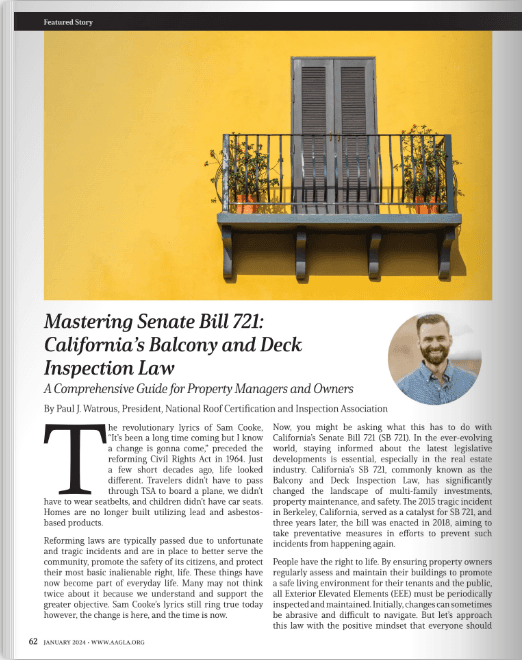
What the SB 721 balcony and deck inspection law requires
California’s SB 721 balcony and deck inspection law is past its opening deadline, and a building that has never been assessed is out of compliance today rather than at some point in the future. The statute grew out of the 2015 balcony collapse in Berkeley that killed six people and injured seven. It was enacted in 2018 and it now sits on the operating calendar of every multifamily rental portfolio in the state.
The law applies to rental buildings with three or more units. It covers exterior elevated elements, usually shortened to EEE: balconies, decks, stairways, walkways and landings raised above ground and supported substantially by wood framing. Those are the assemblies that fail quietly, because the load path runs through a ledger and a joist end that nobody sees until something moves.
- Initial inspection deadline: January 1, 2026. That date has passed.
- Re-inspection cycle: every six years after the initial assessment.
- Companion statute: SB 326 covers condominium and homeowner association property. Its deadline was January 1, 2025, its cycle runs every nine years, and Civil Code 5551 draws its professional pool more narrowly.
Confirm which statute applies to each property before you schedule anything. A mixed portfolio will have both, and the cycles do not line up.
Who is allowed to perform the inspection
The statute names the qualified professional, and the list is short:
- A licensed architect
- A licensed civil or structural engineer
- A contractor holding an A, B or C-5 license with at least five years of experience constructing multistory wood-frame buildings
- A certified building inspector credentialed through a recognized program
Verify the credential before the visit, not after the report lands. A report from someone outside that list does not close your obligation, and you will pay twice to learn it.
Availability is the constraint owners underestimate. The qualifying pool is narrow by design, and restorative work pays better than assessment, so a fair number of eligible professionals decline the inspection side entirely. Book early.
The clock starts when the report lands
Delivery of the report begins two windows. You have 120 days to obtain proposals and pull a building permit for required repairs, then 120 days from permit issuance to complete the work. Conditions that pose an immediate threat require action right away, including restricting access to the element while it is addressed.
Those windows are generous on paper and tight in practice, because they run at the same time as your budget cycle, your permit desk and your contractor’s schedule. An inspection booked early in a fiscal year gives you room. One booked in December does not.
What non-compliance costs
Penalties are commonly cited at 100 to 500 dollars per day until repairs are complete. A building safety lien may also be recorded against the property, with its own associated costs. Both are recoverable numbers.
The number that is not recoverable is the civil exposure from an injury on an element that was never assessed. That is the exposure the statute was written to close, and it is the reason the inspection cycle exists at all.
Where owners get stuck
Two places, consistently.
Finding someone qualified and available. Scheduling ahead of a cycle date instead of reacting to one is what keeps this from becoming an emergency at the worst possible moment.
Funding what the report finds. Deferred maintenance compounds out of sight. A ledger that has been wet for eight years is a structural repair with framing, waterproofing and finish work attached, and the scope can arrive as a genuine financial surprise. That is why the sequence matters: assess, price, permit, repair, document.
The habit this law is ending is the instinct to leave alone anything that has not failed yet. Scheduled assessment costs less across the life of a building, and it is considerably safer for the people living on those balconies.
Where NRCIA fits
Since 1995, NRCIA has set inspection standards and accredited the professionals who apply them. NRCIA does not perform inspections or issue reports. Accredited members do.
The E3GUARD™ program covers exterior elevated elements and carries state tracks named for the statutes they serve, including CA-SB721 and CA-SB326. Members who complete it work from a published methodology covering terminology, scope, timelines, compliance steps and documentation. For an owner with buildings in four counties, that consistency is the practical benefit: a report on one property reads the same as a report on the next, and your file holds together if anyone ever asks to see it.
What to do this quarter
- Inventory every exterior elevated element across your California properties, by building and by unit.
- Pull the inspection history. Anything with no record moves to the top.
- Confirm SB 721 or SB 326 for each property and calendar the next cycle date.
- Verify inspector credentials against the statutory list before booking.
- Reserve funds for repairs the reports will surface, and keep every report, photograph, permit and completion record together.
Find an accredited NRCIA inspector near you at /member-directory/.
LeakFREE®, Forensic ROOF®, Mr. RoofCheck®, InspectionPLUS®, Today’s Inspection… Tomorrow’s Protection®, and Got Leaks?® are registered trademarks of Field Gate FLP, used by permission. RoofGUARD™, ForensicGUARD™, DisasterGUARD™, E3GUARD™, and Think Like a Raindrop™ are trademarks of Field Gate FLP.