Why decks and balconies fail quietly
A balcony gives almost no warning. The surface looks fine while water sits behind a failed waterproofing membrane, works into the ledger connection, and takes the framing apart from the inside. By the time a resident feels a soft spot, the damage is structural. That is the problem a certified deck inspector is trained to find while it is still a repair rather than a collapse.
For an apartment complex, the exposure is doubled. There is the physical risk to residents, and there is the liability that follows a known condition left unaddressed.
California law, now that the deadlines have passed
Two statutes govern exterior elevated elements in California, meaning decks, balconies, walkways, stairways and landings more than six feet above ground that rely on wood or wood-based framing.
SB 721 applies to rental buildings with three or more units. The initial inspection deadline was January 1, 2026. It has passed. Inspections repeat every six years.
SB 326 applies to condominium and homeowner association properties under Civil Code 5551. Its deadline was January 1, 2025. It has also passed. Inspections repeat every nine years.
If a building in your portfolio missed its date, the remedy is to schedule now and document the result. Penalties are commonly cited in the range of 100 to 500 dollars per day, and a jurisdiction may record a building safety lien against the property. An owner who inspects late is in a materially better position than an owner who has never inspected at all, both with a building department and with a jury.
Who is qualified to perform the inspection
The statute names the professionals, and this is where owners most often get it wrong. Under SB 721, the inspection must be performed by a licensed architect, a licensed civil or structural engineer, a contractor holding an A, B or C-5 license with a minimum of five years of experience in multistory wood-frame construction, or a certified building inspector. SB 326 draws from a narrower pool under Civil Code 5551.
Accreditation and licensure do different jobs. A credential such as NRCIA’s E3GUARD™ program builds specialized skill in evaluating exterior elevated elements, and it sits alongside the statutory license rather than replacing it. Before you sign anything, confirm both: the license category the statute requires, and the training that tells you the inspector knows what a failing ledger looks like.
What a certified deck inspector examines
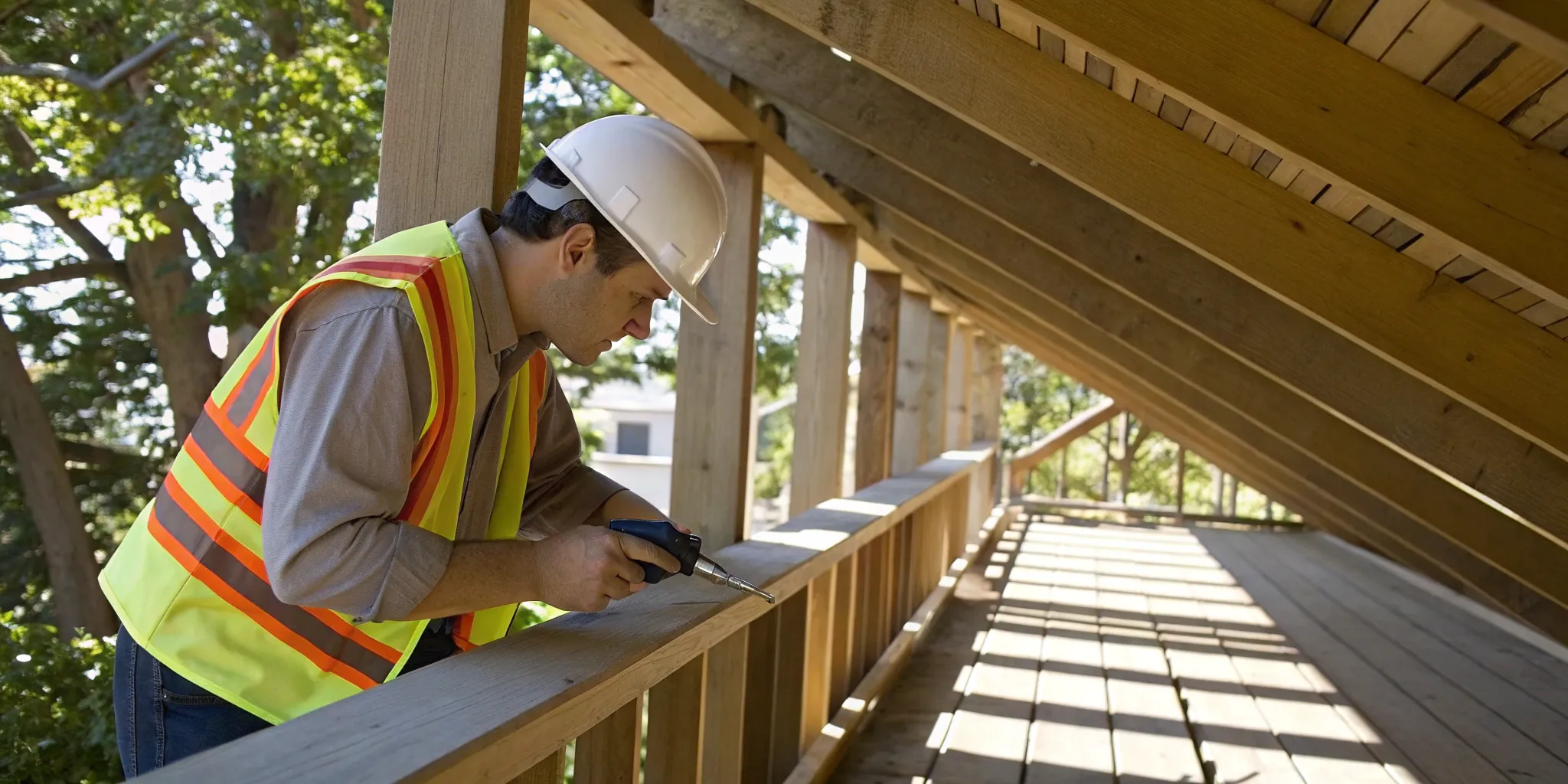
A qualified evaluation is a structural examination, not a walk-around. Expect coverage of:
- The ledger connection where the deck attaches to the building, including bolting, spacing and flashing
- Waterproofing systems, coatings, and the condition of every joint and termination
- Load-bearing members, meaning joists, beams, posts and their hardware
- Guardrails and handrails, including attachment strength, height and baluster spacing
- Drainage, slope, scuppers and any evidence of standing water
- The walking surface and its transitions at doors and thresholds
SB 721 requires that the inspection reach a statistically significant sample of each type of exterior elevated element on the property, and that the inspector report on whether the elements are in a generally safe condition and performing as designed.
What inspectors find most
Water is the common thread. Missing or reversed flashing above the ledger board lets moisture into the rim joist, where rot spreads without a visible surface sign. Coating failure at the wall-to-deck junction does the same thing more slowly. Corroded joist hangers, loose railing connections, cracked stucco at penetrations and balusters spaced wide enough for a small child to pass through all show up regularly.
Smaller findings matter for budgeting. Popped fasteners, hairline cracking in concrete surfaces and peeling sealant are cheap to correct now and expensive to ignore for six years.
How to hire well
Ask five questions before you sign:
- Which statutory qualification do you hold, and can I see the license?
- How many multifamily properties like mine have you evaluated?
- Can you show me a sample report with photographs and prioritized findings?
- Do you carry general liability and workers compensation coverage?
- Do you or your company also perform the repairs you recommend?
That last question matters. An evaluation carries more weight with a carrier, a board and a court when the person writing it has no financial interest in the scope of work that follows.
Reading the report and acting on it
A usable report sorts findings by urgency. Anything described as posing an immediate threat to safety requires you to restrict access to that element and begin emergency repairs, and SB 721 requires notice to the local enforcement agency within 15 days for those conditions. Everything else becomes a maintenance plan with dates attached.
Keep the report. The next cycle comes in six years for SB 721 properties and nine for SB 326, and the previous report is what shows a pattern of care.
Find an accredited NRCIA member inspector near you
LeakFREE®, Forensic ROOF®, Mr. RoofCheck®, InspectionPLUS®, Today’s Inspection… Tomorrow’s Protection®, and Got Leaks?® are registered trademarks of Field Gate FLP, used by permission. RoofGUARD™, ForensicGUARD™, DisasterGUARD™, E3GUARD™, and Think Like a Raindrop™ are trademarks of Field Gate FLP.