Where apartment balcony inspection services stand in 2026
Both California deadlines have passed. If you own or manage multifamily property in the state and you have not completed your exterior elevated element inspection, you are late, and the clock on penalties is already running. Apartment balcony inspection services are no longer a scheduling question. They are a compliance backlog to clear.
Outside California the picture is less formal and the physics are identical. Balconies, decks, landings, stairways and walkways sit outdoors, carry live load, and depend on a waterproofing layer you cannot see from the ground. When that layer fails, the framing beneath it rots quietly for years.
What the California statutes actually require
SB 721: rental buildings with three or more units
SB 721 covers apartment buildings of three units and up. The initial inspection deadline was January 1, 2026. Re-inspection runs on a six-year cycle. The statute names who may perform the work: a licensed architect, a licensed civil or structural engineer, a contractor holding an A, B or C-5 license with a minimum of five years of experience in multistory wood-frame construction, or a certified building inspector.
SB 326: condominiums and homeowner associations
SB 326 governs common interest developments. Its initial deadline was January 1, 2025, and re-inspection follows a nine-year cycle. Civil Code section 5551 sets a narrower professional pool than SB 721 does, so an inspector qualified for one statute is not automatically qualified for the other. HOA boards should verify which statute applies before hiring anyone.
What being late costs
Penalties are commonly cited in the range of 100 to 500 dollars per day of continued noncompliance, and a local building department can record a safety lien against the property. Those figures sit alongside the exposure that matters more: an injury on a structure you were required to inspect and did not.
What a qualified inspector examines
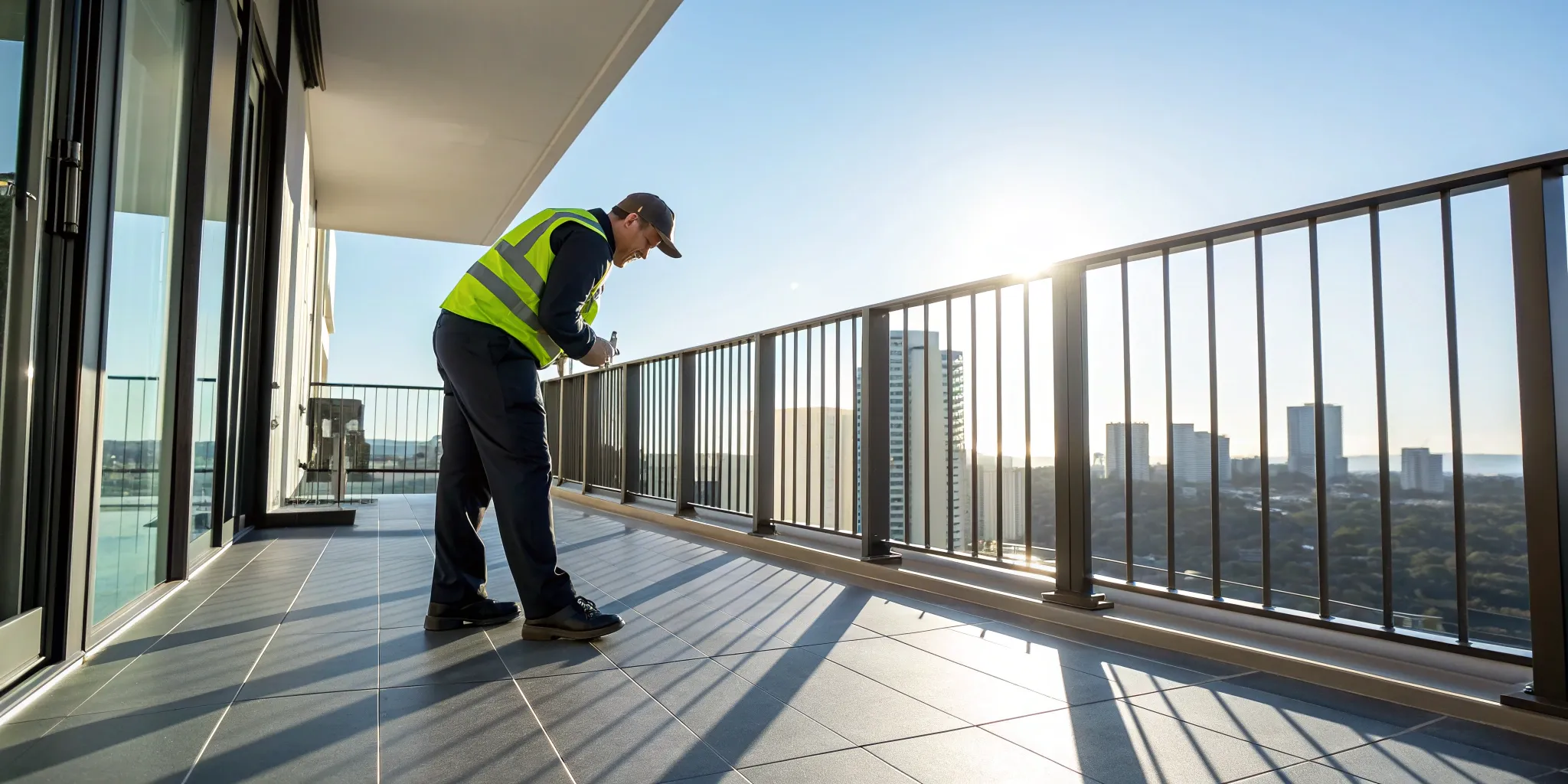
A credible balcony inspection is a structural evaluation, not a walk-around. Expect the inspector to work through four areas.
- Load path and attachment. How the balcony ties into the building frame, whether the platform is level and square, and whether there is any sag, rotation or separation at the connection.
- Waterproofing and drainage. Membrane condition, flashing at the door threshold and the wall junction, slope to drain, and standing water after rain. Water intrusion at the ledger is the failure mode behind the collapses that produced these statutes.
- Material condition. Wood decay and delamination, corrosion on fasteners and steel supports, cracking and spalling in concrete, efflorescence on masonry.
- Guardrails. Height, attachment, baluster spacing, and lateral resistance. Codes generally set guard height at 42 inches and require the assembly to resist a 200 pound concentrated load.
Where visual evidence is inconclusive, the statutes contemplate destructive testing to expose the framing. A responsible inspector will tell you before opening anything, and will document the opening and its repair.
The report is the deliverable
A pass or fail grade is worthless to you. The report you keep on file should identify each element by unit, state its condition, carry dated photographs, separate immediate hazards from planned maintenance, and name the standard applied. Under SB 721 the report goes to the building owner and stays available for the next inspection cycle. Under SB 326 the report goes to the association board.
If an inspector finds a condition that poses immediate danger, the balcony has to be closed to use and the local code enforcement office notified. Plan for that possibility in advance rather than improvising with residents standing in the courtyard.
How to choose among apartment balcony inspection services
Start with the statute, then the credential, then the record.
- Confirm statutory eligibility. Ask which license the inspector holds and match it against SB 721 or Civil Code 5551. A general handyman cannot produce a valid report, and an invalid report leaves you noncompliant after you have paid for it.
- Ask about accreditation in exterior elevated elements. NRCIA trains and accredits members through E3GUARD™, with state tracks for CA-SB721 and CA-SB326. An E3GUARD™ Accredited Specialist has been trained specifically on decks, balconies, walkways, patios and staircases.
- Verify insurance. General liability and workers compensation, current, in writing.
- Read a sample report before you hire. If the sample is thin, yours will be thin.
- Ask about local practice. Permit requirements for follow-up repairs vary by city and county, and an inspector who works your jurisdiction regularly will save you weeks.
What drives the price
There is no flat rate, and any quote given before someone has seen a unit count should make you cautious. Cost tracks the number of elements, the construction type, access, the share of units requiring interior entry, and whether destructive testing is anticipated. Budget the inspection as a recurring line item on the statutory cycle instead of an emergency expense, and get more than one quote so you can compare scope rather than price alone.
After the report: sequencing repairs
Triage by hazard, not by cost. Anything flagged as an immediate threat gets closed off and repaired now. Everything else goes into a schedule with named contractors, permit steps and dates. Keep the inspection report, the repair scope, the permits and the sign-offs together in one file. That package is what protects the ownership entity if the property is ever sold, refinanced or litigated.
Deferred balcony repair does not hold steady. Water that reached the framing keeps moving, and a contained repair becomes a structural one over a couple of wet seasons.
Start with a qualified inspector
Compliance turns on hiring someone the statute actually recognizes. NRCIA maintains a national directory of accredited members, including E3GUARD™ specialists working the California tracks.
Find an accredited NRCIA inspector for your property in the member directory.
LeakFREE®, Forensic ROOF®, Mr. RoofCheck®, InspectionPLUS®, Today’s Inspection… Tomorrow’s Protection®, and Got Leaks?® are registered trademarks of Field Gate FLP, used by permission. RoofGUARD™, ForensicGUARD™, DisasterGUARD™, E3GUARD™, and Think Like a Raindrop™ are trademarks of Field Gate FLP.