What a Roof Failure Cause and Origin Expert Does
A roof failure cause and origin expert answers a narrow question: what caused this, and where did it start. That is a different job from repairing a roof. The repair trade is paid to make water stop. A cause and origin investigation is paid to establish, with documented evidence, whether the failure came from a weather event, a defective installation, a defective product, or ordinary age.
The distinction is not academic. It decides who pays. Storm damage sits with a carrier. A nailing pattern that never met specification sits with the contractor who installed it. A shingle that failed inside its stated term sits with the manufacturer. Age sits with the owner. A claim gets denied for lack of proof far more often than for lack of damage, and proof is what this work produces.
What Actually Makes Roofs Fail
Roofs rarely fail from one cause. They fail from a combination that accumulated.
- Weather. Wind lifts and creases shingles and breaks the adhesive seal even where nothing is missing. Hail bruises the mat and strips granules. Ultraviolet exposure makes asphalt brittle over years.
- Installation. Wrong nailing pattern, nails driven high or overdriven, inadequate headlap, flashing at chimneys and sidewalls that was sealed rather than lapped, ventilation that never met the required net free area.
- Materials. A product outside its specification, or a product that was correct but wrong for the slope it was applied to.
- Maintenance and age. Blocked drainage, debris held against the covering, unaddressed penetrations, and simple end of service life.
An investigation that stops at the first plausible answer usually gets the assignment of responsibility wrong.
How the Investigation Works
Physical Evidence
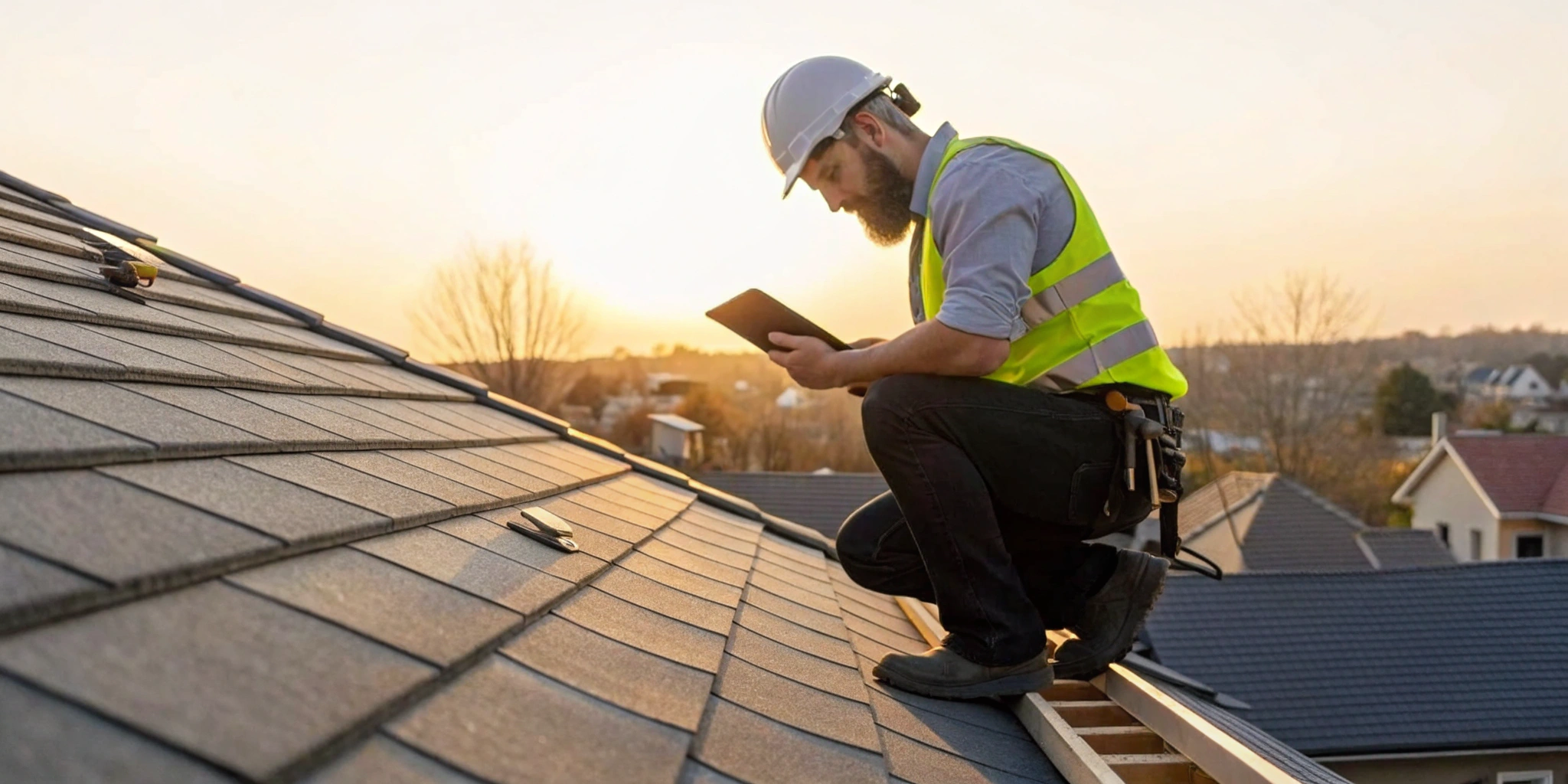
The work starts on the roof and in the attic. The inspector documents the covering, the flashings, the penetrations, the drainage, the decking and the framing, then works the interior for staining, damp insulation and rot. Damage patterns carry information. Hail leaves a random distribution with a size signature. Wind leaves a directional pattern concentrated at edges and rakes. Installation defects appear systematically across the whole roof rather than in one exposed area.
Instrumented Testing
Thermal imaging shows temperature differentials that indicate trapped moisture in an assembly. Electronic moisture meters confirm and bound the saturated area, which is almost always larger than the visible stain suggests. Where the assembly has to be opened, a core sample taken cleanly through the layers shows the original construction, the material sequence and where water sits between layers.
Records and Weather History
Documents finish the picture. Original plans and permits, the installation contract and product submittals, maintenance logs, and prior repair invoices. Historical weather data for the address establishes whether a qualifying event actually occurred on the date claimed, and how severe it was. Cross-referencing that record against the physical damage is what turns an opinion into a timeline.
The Report, and How to Prepare for the Visit
The deliverable is a written report: the scope of damage, the evidence, the stated cause with the reasoning that supports it, and specific repair recommendations. Photographs and test results are part of it. A report built this way can be read by an adjuster, a contractor and, if the matter goes further, opposing counsel.
You can make the investigation faster and more accurate by having three things ready. Photograph everything you can safely reach before anyone touches the roof, and note when you first saw the problem. Pull the roof’s paper history, the installation contract, warranties and every repair invoice. If a claim is open, have the policy and a written timeline of who you spoke to and when.
What to Look For When You Hire One
There is no federal license for roof inspectors. A contractor’s license says a person may perform construction work in a state. It says nothing about training in failure analysis, evidence handling or report writing that will hold up under cross-examination. That gap is why credentials matter more here than in most trades.
Look for accreditation specific to forensic roof investigation, a documented history of investigations rather than installations, and comfort with the instruments described above. Ask how many cause and origin investigations the person has completed, how evidence is preserved, and whether they have testified. NRCIA accredits members through the ForensicGUARD™ program, where an accredited individual carries the NRCIA Forensic Roof Inspector designation and advances to Senior and Master levels with documented inspection volume.
Find a Forensic Roof Inspector
NRCIA sets the standard and trains and accredits the members who perform this work. The investigation, the findings and the report come from the accredited individual, not from the association.
Find an accredited NRCIA inspector near you and request a cause and origin investigation
LeakFREE®, Forensic ROOF®, Mr. RoofCheck®, InspectionPLUS®, Today’s Inspection… Tomorrow’s Protection®, and Got Leaks?® are registered trademarks of Field Gate FLP, used by permission. RoofGUARD™, ForensicGUARD™, DisasterGUARD™, E3GUARD™, and Think Like a Raindrop™ are trademarks of Field Gate FLP.