
What a forensic roof inspection is
A standard inspection answers what is wrong. A forensic roof inspection answers why, and produces evidence that survives someone else reading it. That distinction matters when a leak has already been patched twice, when a new roof is failing, or when the answer will end up in a claim file or a construction defect matter.
Water makes this necessary. It enters at a nail hole or a lifted flashing leg, runs down the underside of the deck, tracks along a rafter, saturates insulation, and appears on drywall well away from the entry point. Repairing the ceiling below the stain treats the last inch of a journey that began somewhere else.
When to order one
- A leak that keeps coming back. Two failed repairs at the same location usually means the entry point was never found.
- A new roof that is already leaking. An inspection shortly after installation checks the work against manufacturer instructions and code, while the contractor is still on the hook.
- A disputed insurance claim. Causation is the argument, and causation is what this inspection documents.
- Litigation or an expert witness need. Attorneys working construction defect matters need findings recorded to a method, not an opinion recorded after the fact.
- Due diligence on a purchase. Particularly on commercial or multifamily property where a roof replacement is a capital event.
Warning signs that justify the deeper look
Stains and mold are the obvious ones. Watch also for a musty smell in an attic after rain, insulation that has clumped or flattened in patches, rust on nail shanks or truss plates, and rising heating or cooling costs with no other explanation. Sagging in a roofline, or interior doors that suddenly stick, points at moisture in the framing and warrants immediate attention rather than a maintenance call.
The tools, and what each one actually shows
Infrared thermal imaging
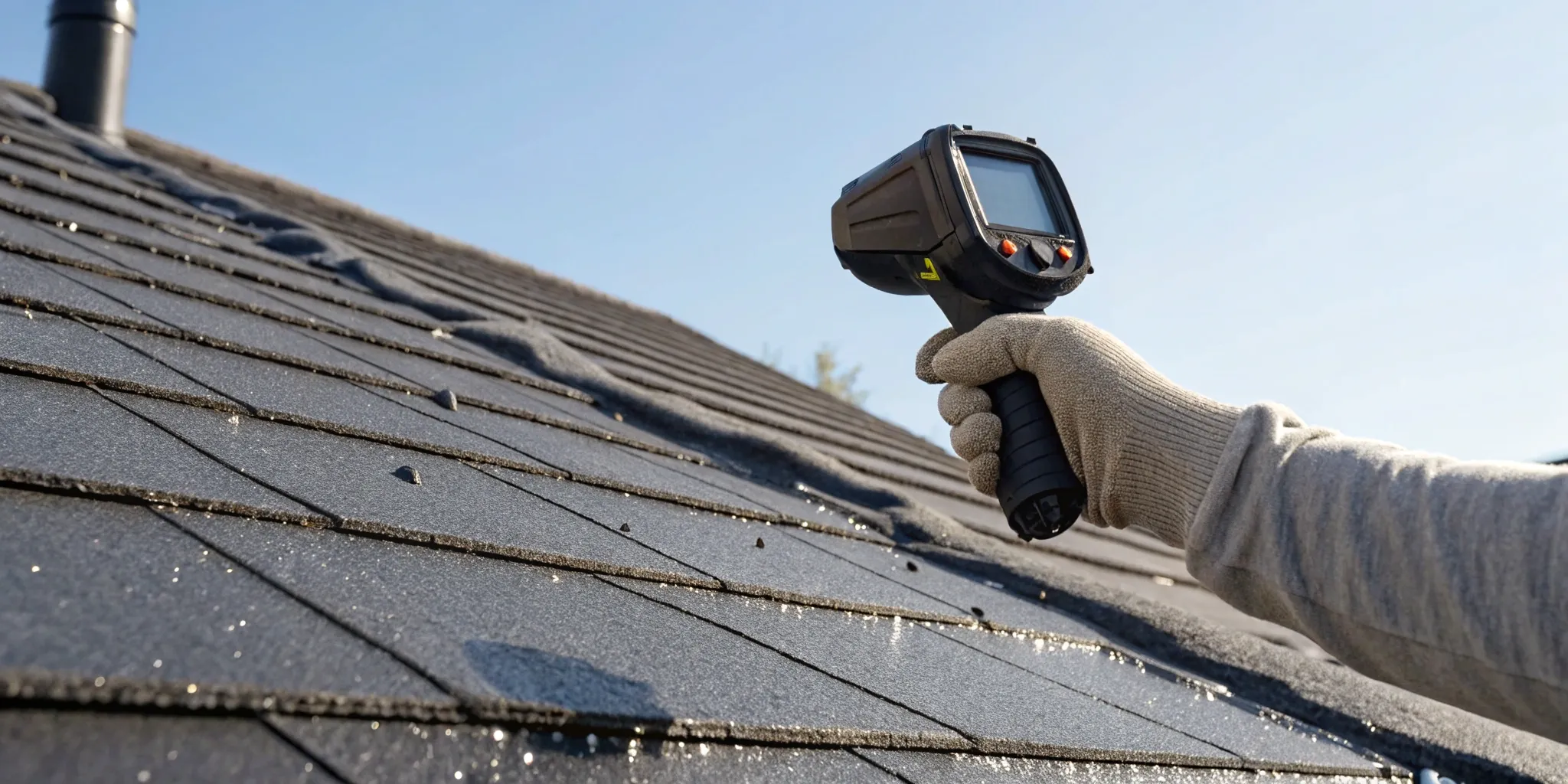
Wet material holds and releases heat differently than dry material. Under the right conditions, usually late in the day as the roof cools, an infrared camera renders trapped moisture as a distinct pattern. It maps where water is sitting. Interpretation still belongs to the inspector, because a thermal anomaly can also be a shadow, a repair patch or a mechanical unit.
Moisture meters
Handheld meters confirm what the camera suggested, giving readings in decking, insulation and framing. This is the step that converts a pattern on a screen into a number in a report.
Drones
For roofs that are too steep, too large or too fragile to walk, a drone carrying a high-resolution or infrared camera covers the field safely and captures overall imagery that ground photographs cannot.
Sampling and destructive testing
Sometimes the answer is under the membrane. A small core taken at a documented location can confirm saturated insulation, a manufacturing defect or a missing layer. A competent inspector tells you before opening anything, photographs the opening, and repairs it.
How the investigation runs
The sequence is deliberate, and each step narrows the field.
- History. When the leak started, what weather preceded it, who has worked on the roof, what was repaired and by whom. Your records shorten the search more than any tool does.
- Visual assessment. Hands-on examination of flashing, penetrations, laps, terminations, drainage and attic conditions, checked against manufacturer instructions and applicable code.
- Instrumented survey. Thermal imaging and moisture readings to map the extent of intrusion and trace it upslope toward the entry point.
- Analysis. Separating installation error from material failure from weather event. These three carry very different remedies and very different parties responsible.
- Report. Findings, dated and located photographs, method used, conclusions, and a scope of recommended work.
Installation error, material failure or weather
Most persistent leaks resolve into one of those three. Installation error shows up as incorrect nail placement, reverse-lapped flashing, inadequate headlap, missing kick-out flashing at a wall termination, or sealant substituted for a metal detail. Material failure shows up as blistering, splitting, granule loss beyond the expected curve for the roof’s age, or a defect consistent across a production run. Weather leaves impact signatures and directional creasing that a trained inspector can distinguish from wear.
Naming which one it is determines who pays. That is why the documentation standard has to be higher than a photo album.
Choosing an inspector
No federal license exists for roof inspectors, so the credential is what you have to work with. NRCIA trains and accredits members through ForensicGUARD™, the association’s flagship program, which produces the NRCIA Forensic Roof Inspector designation and its senior and master grades. Members handling insurance-related evaluations add DisasterGUARD™.
Ask three things. How many forensic investigations have you completed and can you describe one? What instruments do you carry and under what conditions do you use them? May I see a redacted sample report? A specialist will answer all three without hesitation.
Using the report
Read it before you spend anything. Address the identified source before secondary damage, since repairing the ceiling while the entry point stays open buys nothing. Give the same report to every contractor you ask for a bid so the quotes describe identical work. Send it to your carrier as third-party documentation of cause. If a contractor is responsible, the report is what turns a complaint into a claim with specifics attached.
Findings are recorded through InspectionPLUS®, which keeps the format consistent across members and across time.
Find someone qualified to run the investigation
A recurring leak is a diagnosis problem before it is a repair problem. Start with an accredited member trained to document causation.
Find an accredited NRCIA inspector near you in the member directory.
LeakFREE®, Forensic ROOF®, Mr. RoofCheck®, InspectionPLUS®, Today’s Inspection… Tomorrow’s Protection®, and Got Leaks?® are registered trademarks of Field Gate FLP, used by permission. RoofGUARD™, ForensicGUARD™, DisasterGUARD™, E3GUARD™, and Think Like a Raindrop™ are trademarks of Field Gate FLP.
