A new member benefit: Drone Pilot Ground School
NRCIA has partnered with UAV’s Drone Pilot Ground School, an online test preparation course for the FAA Part 107 remote pilot certificate. Members can enroll through the member portal at a discounted rate on the one-time course fee.
Aerial imagery has become a working tool in roof inspection, particularly on steep slopes, on multi-story elevations, and on any roof where walking the covering would damage it. Flying for that purpose is commercial operation, and commercial operation requires a certificate.
Who needs an FAA Part 107 certificate
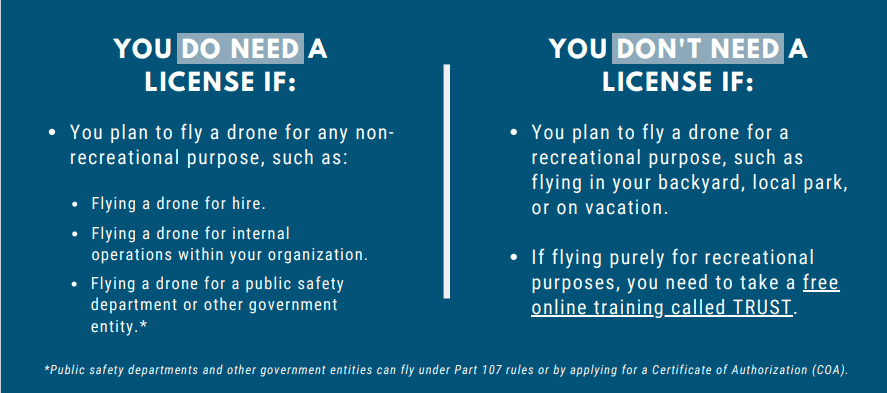
Anyone flying a drone for a non-recreational purpose needs a Remote Pilot Certificate from the Federal Aviation Administration under Part 107. Photographing a client’s roof for a paid inspection is non-recreational, even when the flight lasts four minutes and never leaves the driveway.
To be eligible you must be at least 16 years old, be able to read, speak, write and understand English, and be in a physical and mental condition to operate safely. The certificate is valid in all US states and territories.
On currency: the certificate itself does not carry an expiration date. To keep exercising its privileges you complete free FAA online recurrent training every 24 calendar months. The old 24-month retest at a testing center was replaced by that online course.
What the Part 107 knowledge test covers
The initial test is taken at an FAA-approved knowledge testing center. It runs 60 multiple-choice questions with a two-hour limit, and a score of 70 percent or better passes. The Airman Certification Standards for small unmanned aircraft list more than 120 concepts, including:
- Regulations and operating limitations under Part 107
- The National Airspace System and reading sectional charts
- Airport operations and radio communication procedures
- Remote ID requirements
- Night operations and lighting
- Weather sources and micrometeorology
- Loading, performance and emergency procedures
- Crew resource management and aeronautical decision-making
- Physiological effects of drugs and alcohol
Worth knowing: Part 107 does not require you to demonstrate flight proficiency to earn the certificate. The written test is the gate. Drone Pilot Ground School covers the tested concepts and also offers hands-on flight sessions with instructors for members who want stick time before they fly over a client’s property.
How long it takes
Most students finish in four to six weeks. The self-paced lessons and practice tests typically take 15 to 20 hours spread across two or three weeks. After passing the test you complete an online application, and the temporary certificate generally arrives within a few business days once vetting clears.
Where a drone fits in a member’s inspection
Aerial imagery supplements the inspection protocol. It does not replace it. The five-zone LeakFREE® Check covers the interior, attic, exterior, perimeter and rooftop, and four of those five zones are on the ground or inside the building. A drone earns its place by documenting rooftop conditions the inspector cannot safely reach, by capturing the overall roof geometry for the report, and by giving a client a picture of what the written findings describe.
Used that way, it shortens the time on a steep roof and strengthens the LeakFREE® Roof Inspection Report. Used as a substitute for the protocol, it produces a photograph rather than an inspection.
Join NRCIA
Partner training rates, the accreditation programs and the member portal come with membership. RoofGUARD™ accreditation is where most inspectors start, and ForensicGUARD™ is where the cause-of-loss and expert work lives.
Review membership and start accreditation: /join-nrcia/
LeakFREE®, Forensic ROOF®, Mr. RoofCheck®, InspectionPLUS®, Today’s Inspection… Tomorrow’s Protection®, and Got Leaks?® are registered trademarks of Field Gate FLP, used by permission. RoofGUARD™, ForensicGUARD™, DisasterGUARD™, E3GUARD™, and Think Like a Raindrop™ are trademarks of Field Gate FLP.