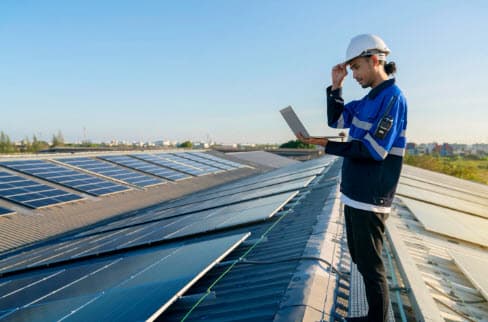
Your roof has to carry the array for decades
Solar panels are built to produce for 25 to 30 years. The roof underneath them has to last at least that long, or the math stops working. If the deck needs work five years after a solar panel installation, the panels come off, the roof gets repaired, and the panels go back on. That sequence is expensive, and it is avoidable.
Put the roof work ahead of the array. Here is the order that keeps the cost down.
Step 1: Book a roof inspection before the solar panel installation
An accredited NRCIA member inspects the roof before anyone quotes racking. NRCIA members work for the property owner rather than for the installer, which is what makes the finding useful.
A pre-installation inspection covers:
- Active leaks, staining, and evidence of prior water intrusion
- Remaining service life of the shingles, tiles or panels
- Visible condition of the structural support. Anything questionable goes to a structural engineer for evaluation.
- Locations where mounting hardware would land badly
NRCIA members perform this work as a LeakFREE® Check, a five zone inspection covering interior, attic, exterior, perimeter and rooftop, and deliver a LeakFREE® Roof Inspection Report you can hand to the solar contractor.
Step 2: Repair what the inspection finds
Worn shingles, failed flashing, soft decking. Fix these while the roof is still open and reachable. A small defect under a fixed array is much harder to get to and much more expensive to correct.
If the roof is near the end of its service life, replacing it before the panels go up is usually the cheaper path. Many homeowners reroof and install solar in the same window for that reason.
Step 3: Understand how the panels attach
Racking systems fasten to the roof structure. Installers locate rafters or trusses, drill, set brackets, and flash each penetration so water is directed back onto the roof surface rather than under it. Performed to the manufacturer’s instructions by a trained crew, penetrations are routine work.
Two details are worth watching: how many penetrations the design calls for, and how each one is flashed. Your inspection report tells the installer where the roof is weakest before the drill comes out.
Step 4: Inspect the roof after the panels are up
Schedule a post-installation inspection once the array is energized. An NRCIA member checks every accessible penetration for correct flashing integration, looks for damage from foot traffic and staging, and documents the condition of the roof as it now stands.
That report matters later. If a leak shows up in year three, a dated record of roof condition at handover helps establish whether the roof or the installation is the source.
Step 5: Put the roof on a schedule
- Have the roof inspected yearly, and after any significant storm
- Watch flashing and mounting points, which is where movement shows up
- Clean panels with water and a soft brush. Harsh chemicals can damage roof coatings and sealants.
- Use licensed contractors and accredited NRCIA members for anything that touches the roof surface
Questions homeowners ask
Do I need a roof inspection if the roof looks fine?
Ground level looks tell you very little. Granule loss, lifted flashing and saturated decking are not visible from the driveway.
What if my roof is too old for solar?
Replace it, then mount the array. Pulling and resetting panels to reroof later costs far more than doing the roof in the right order.
Can a solar panel installation damage my roof?
Poor flashing and misplaced fasteners can cause leaks. Correct detailing and an inspection at handover are how you catch those before they cost you.
Get the roof documented before you sign the solar contract
A LeakFREE® Roof Certification records that a specific roof, at a specific address, on a specific date, met the published LeakFREE® criteria. The term is set by the findings, the slope, the materials and the condition, to a maximum of ten years, and it is generated and registered through InspectionPLUS®. It records condition on a date. It is not insurance, and it makes no promise about future performance. LeakFREE® is our federally registered trademark. Only NRCIA members can issue a LeakFREE® certification.
Find an accredited NRCIA inspector near you in the NRCIA member directory.
LeakFREE®, Forensic ROOF®, Mr. RoofCheck®, InspectionPLUS®, Today’s Inspection… Tomorrow’s Protection®, and Got Leaks?® are registered trademarks of Field Gate FLP, used by permission. RoofGUARD™, ForensicGUARD™, DisasterGUARD™, E3GUARD™, and Think Like a Raindrop™ are trademarks of Field Gate FLP.