Why roof leak cause determination starts away from the stain
Water does not fall straight down through a building. It enters at a break, runs along the underside of the deck, tracks down a rafter, crosses an insulation batt, and drips through the ceiling wherever it finds a low point. The stain marks the exit. Roof leak cause determination is the work of finding the entrance, which can sit several feet away, uphill, in a direction that feels wrong.
Think Like a Raindrop™. Ask where the water landed, which way gravity carried it, and what it touched on the way. That question, asked patiently, solves most leaks. Chasing the stain solves almost none of them.
The failures behind most leaks
Compromised field material
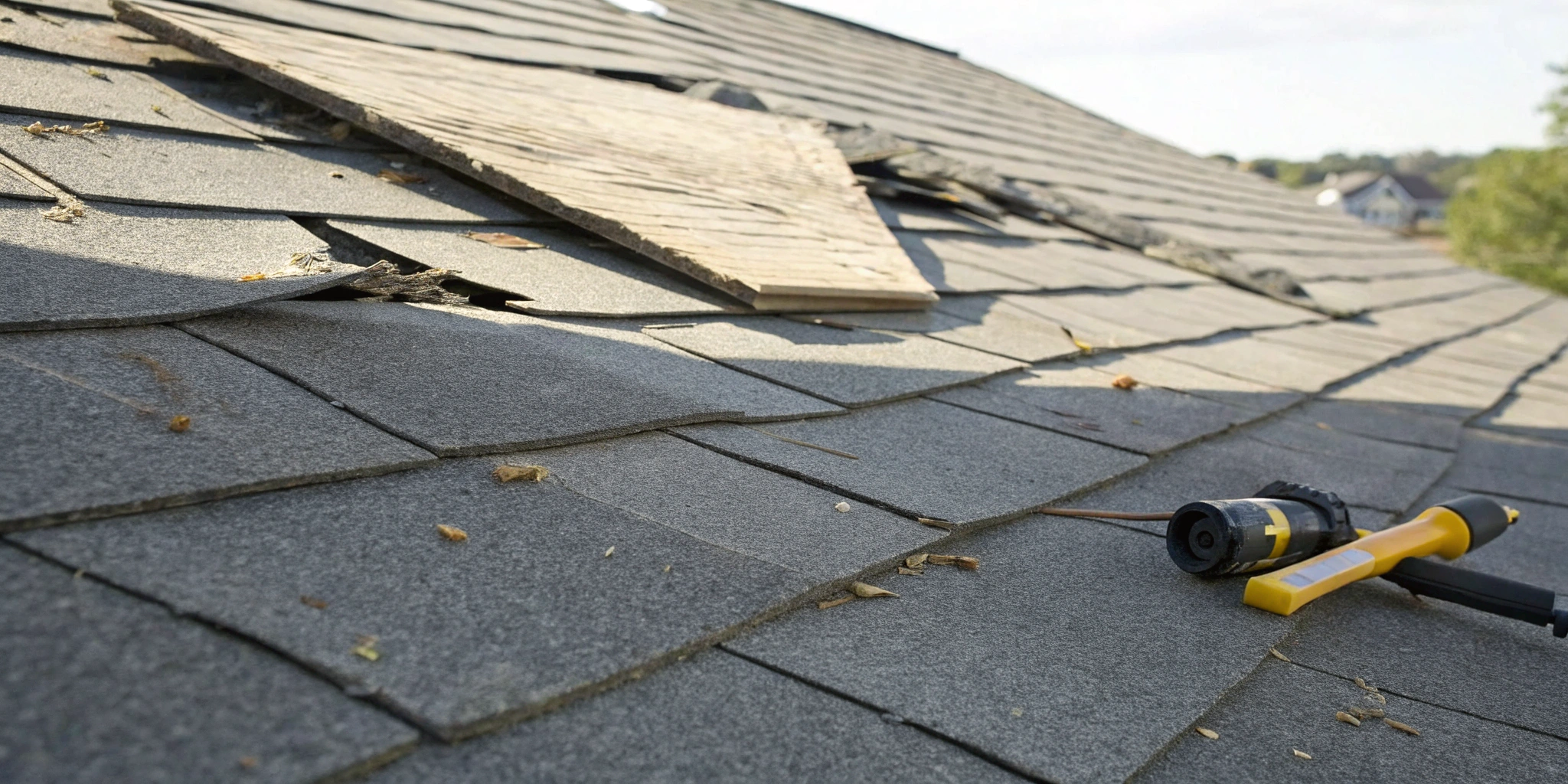
Wind lifts and tears shingles. Hail cracks them and knocks granules loose. Age curls the edges and dries the sealant strip until tabs stop bonding. Any of those exposes the underlayment and then the deck.
Flashing and sealant
Flashing handles every place the roof plane meets something else: a chimney, a skylight, a vent, a wall. Metal corrodes, fasteners back out, and the sealant behind it shrinks and cracks. Joints and transitions produce a large share of the leaks that get diagnosed as a bad roof.
Drainage that has stopped draining
Clogged gutters hold water at the eave until it backs under the shingle course. On a low-slope roof, a blocked drain or scupper does the same across a whole field. In cold climates the same blockage feeds ice dams, which push meltwater uphill under the covering.
Installation error
A new roof leaks for a reason, and the reason is usually workmanship. Reverse-lapped underlayment, short nails, overdriven fasteners, flashing set on top of the covering instead of woven into it. Age is not always the culprit.
Work the problem from the inside out
Roof leak cause determination is done from the inside out. Start in the room below the stain, then go up into the attic with a good flashlight.
Look for four things.
- Scan the underside of the deck for dark staining, streaking and mold.
- Press the insulation. Damp, matted or discolored batts mark the path.
- Look at the nails. Rusted shanks show where moisture has been sitting, and they map the wet zone better than a stain does.
- Check every penetration from below: chimney, plumbing stack, bath fan, skylight curb.
Then trace the staining to its highest point. That upper end is the closest thing you have to the entry, and it gives you a target on the exterior instead of a guess.
The controlled water test
When the attic evidence runs out, wet the roof deliberately. This takes two people. One stays inside watching the suspect area, the other works a garden hose outside, starting low, just above the interior damage, and isolating small sections for several minutes each before moving up. Use a gentle flow. The aim is to imitate rain, not to blast the covering.
Work upward slowly. The section that produces a drip is the section that failed. Skipping around wastes the test, because once the assembly is wet everywhere, nothing you learn afterward can be attributed to one area.
Mistakes that derail roof leak cause determination
Assuming the breach is directly overhead. It rarely is, and every hour spent on the wrong section of roof is an hour the water keeps moving.
Reading condensation as a leak. Warm humid indoor air hitting a cold deck condenses and drips. So does a sweating supply line. Both look like roof failure and neither is fixed by roofing. Poor attic ventilation is the usual driver, and correcting the ventilation is the actual repair.
Poking the bulge. A sagging, water-filled ceiling is alarming, and puncturing it can drop a large wet section of drywall on whatever is underneath. Put a container beneath it and call someone.
Overlooking the joints. Field material gets the blame. Valleys, transitions, curbs and terminations produce the failures.
Tools that separate a guess from a diagnosis
Binoculars from the ground catch missing tabs, lifted flashing and debris without anyone climbing. A moisture meter confirms what a stain suggests, with pin-type probes giving a precise reading at a point and pinless meters scanning a broader area below the surface. Infrared imaging reveals temperature differences that indicate trapped moisture in an assembly, which matters on low-slope roofs where saturated insulation hides under an intact membrane.
Safety governs all of it. A steep pitch, a wet or mossy surface, a second story, a brittle old deck, any of those is a reason to stop. No leak is worth a fall.
When to bring in an accredited inspector
Hand the roof leak cause determination to a professional when the source resists a methodical search, when the roof is steep or high, when the attic is unsafe to enter, or when the answer has to hold up in front of an adjuster or an attorney. There is no federal license for roof inspectors, so the credential behind the report is what tells you the training was real.
NRCIA trains and accredits members through RoofGUARD™ and, for investigative work on disputed causes, ForensicGUARD™. A member performing a LeakFREE® Check examines interior, attic, exterior, perimeter and rooftop and issues a LeakFREE® Roof Inspection Report describing the observed cause with photographs. Where the roof meets the published criteria, that member can issue a LeakFREE® Roof Certification, a dated record of condition with a term set by the findings and a ten year maximum. It is not insurance and it does not promise the roof will never leak.
LeakFREE® is our federally registered trademark. Only NRCIA members can issue a LeakFREE® certification.
Find the entry point, then fix it once
A patch aimed at the wrong spot buys a dry week. Roof leak cause determination is what makes the repair hold. Find an accredited NRCIA inspector near you in the member directory and get the cause identified before the repair is scheduled.
LeakFREE®, Forensic ROOF®, Mr. RoofCheck®, InspectionPLUS®, Today’s Inspection… Tomorrow’s Protection®, and Got Leaks?® are registered trademarks of Field Gate FLP, used by permission. RoofGUARD™, ForensicGUARD™, DisasterGUARD™, E3GUARD™, and Think Like a Raindrop™ are trademarks of Field Gate FLP.