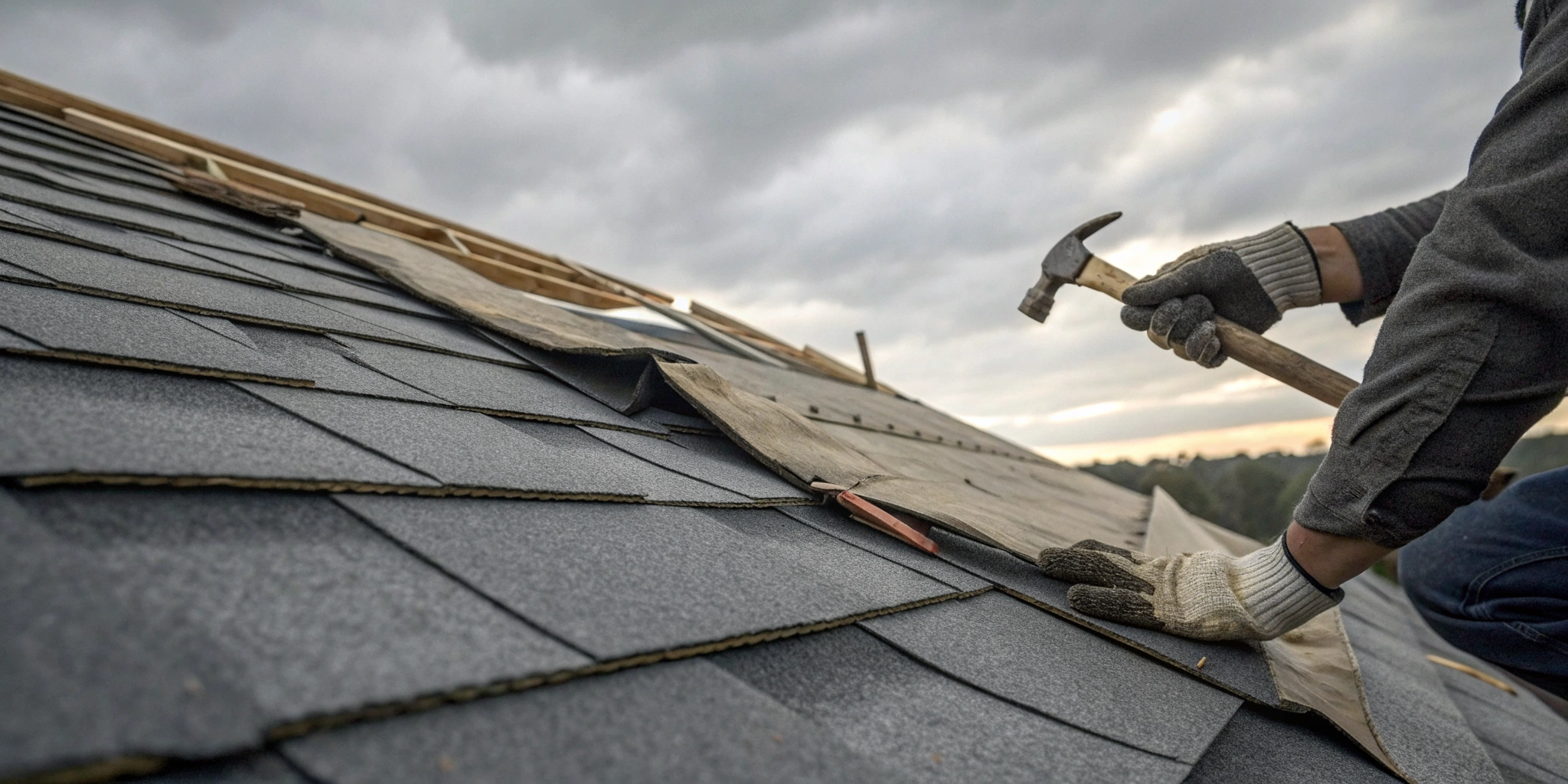
Signs of a Roof Installation Error You Can See From the Ground
A roof installation error usually leaves a mark you can see without a ladder. Stand back about thirty feet, look at the whole plane of the roof, and check three things: the shingle lines, the metal, and the ridge.
Shingle courses that wander
Shingles are staggered like brick, so the vertical seams never stack. Stacked seams create a straight channel for water to travel under the course above. From the ground you are looking for wavy rows, courses that drift out of parallel, and tabs that lift or curl within the year. Lifted tabs often mean the nails sat too high, too deep, or outside the nailing strip.
Flashing that was sealed instead of integrated
Flashing is the metal that carries water away from anywhere the roof meets something else: a chimney, a vent pipe, a dormer wall, a skylight. Chimney flashing is a two-part assembly. Base flashing goes under the shingles, and counter-flashing is cut into the mortar joint above it. A bead of caulk or roof tar in place of that mortar joint is a shortcut. Caulk moves and cracks with the seasons. Mortar does not.
A ridge that dips
Sight down the ridge and the eave. Both should read straight. A dip, a hump, or a soft spot points at the decking or at the framing under it, and low spots hold water. That is a structural question, not a cosmetic one, and it needs a professional look quickly.
What the Attic Tells You
The attic is where an installation problem shows up before your ceiling does. Take a flashlight, and go up after a heavy rain if you can.
- Wet or matted insulation. Insulation should be dry and lofty. Compressed, discolored or damp batts mean water is arriving from above.
- Stains on the underside of the deck. Dark streaks and rings on the sheathing map back to a failure point on the roof directly above them.
- Daylight. Turn the flashlight off and let your eyes adjust. Pinpricks of light around nails or along a seam are open paths for water.
- Trapped heat and condensation. A balanced system needs intake at the eave and exhaust at the ridge. Blocked soffits, missing vents or frost on the nail points in winter all point to a ventilation design that was never finished.
Poor ventilation is the quiet one. It cooks shingles from underneath in summer, feeds ice dams in winter, and shortens the service life of the whole assembly without ever producing a dramatic leak.
What Weather Exposes
Weather is the honest test. After the next storm, check the attic deck for damp spots, then scan the top-floor ceilings and the tops of exterior walls for discoloration. Water inside a roof that is months old is a workmanship question, and it is worth documenting the date and the location with photographs while the evidence is fresh.
Watch the utility bill too. A sudden jump in heating or cooling cost after a reroof often traces back to attic ventilation and sealing rather than to the utility company.
What a Roof Installation Error Costs You Later
Two consequences catch homeowners off guard.
The manufacturer warranty. Shingle manufacturers publish installation instructions covering nailing pattern, underlayment, starter course and ventilation. Work that departs from those instructions can give the manufacturer grounds to decline a material claim, which moves the cost back onto you.
The homeowner policy. Standard homeowner policies generally exclude damage caused by faulty workmanship. Read your own policy language, because the exclusion is where most of these claims stop.
Then there is resale. Uneven courses and rusted flashing are visible in a listing photo, and a buyer’s inspector will find the rest.
What to Do When You Find One
- Go back to the installer with your contract in hand. Put the issues in writing, attach dated photographs, and reference the workmanship warranty in your agreement. Most reputable roofers will come back out.
- Get an independent inspection. If the installer disputes the finding or stops responding, an inspector with no stake in the original job gives you a documented, impartial record of what is wrong and where.
- Know your options before you spend. Review your policy for the workmanship exclusion, and if the repair cost is significant, a construction law attorney can tell you what your contract actually entitles you to.
Where an Accredited Inspection Fits
There is no federal license for roof inspectors. That is why the training behind the person on your roof matters, and why NRCIA has set the inspection standard since 1995.
NRCIA members trained through the RoofGUARD™ program perform a LeakFREE® Check, a five-zone inspection covering the interior, attic, exterior, perimeter and rooftop, and issue a LeakFREE® Roof Inspection Report. Where the roof meets the published criteria, the member who performed the inspection can issue a LeakFREE® Roof Certification through InspectionPLUS®. That certification records the condition of a specific roof, at a specific address, on a specific date, for a defined term of up to ten years. It is a record of condition, not a promise about future weather, and it is not insurance.
Across 6,460 member inspections nationwide, more than 66 percent of roofs either qualified for a LeakFREE® certification or could be repaired to qualify. A documented inspection tells you which side of that line your roof is on.
Find an accredited NRCIA inspector near you in the member directory.
LeakFREE®, Forensic ROOF®, Mr. RoofCheck®, InspectionPLUS®, Today’s Inspection… Tomorrow’s Protection®, and Got Leaks?® are registered trademarks of Field Gate FLP, used by permission. RoofGUARD™, ForensicGUARD™, DisasterGUARD™, E3GUARD™, and Think Like a Raindrop™ are trademarks of Field Gate FLP.