Signs You Need a Professional to Find a Roof Leak
Most roofs do not announce a leak with a drip in a bucket. They announce it quietly, weeks or months after water started moving, which is why the decision to hire a professional to find a roof leak usually arrives late. Water finds every weakness. Learning to read the early signals gets you ahead of it.
- Ceiling and wall staining. Brown rings or discolored patches, especially ones that change shape after rain. A stain that feels dry means the water stopped for now, not that the path closed.
- Bubbling or peeling paint. Moisture trapped behind the surface.
- A musty smell in upstairs rooms or the attic. Persistent earthy odor points to moisture you have not found yet.
- Attic evidence. Dark streaks on rafters or sheathing, compressed or damp insulation, daylight where there should be none.
- Granules in the gutters. Sand-like material washing off asphalt shingles means they are aging out of their protective layer.
- Missing, cracked or curling shingles. Visible from the ground with no ladder required.
- A dip or sag in the roofline. This one is urgent. Sagging suggests the decking underneath has been wet long enough to rot.
Why This Is Not a Do-It-Yourself Job
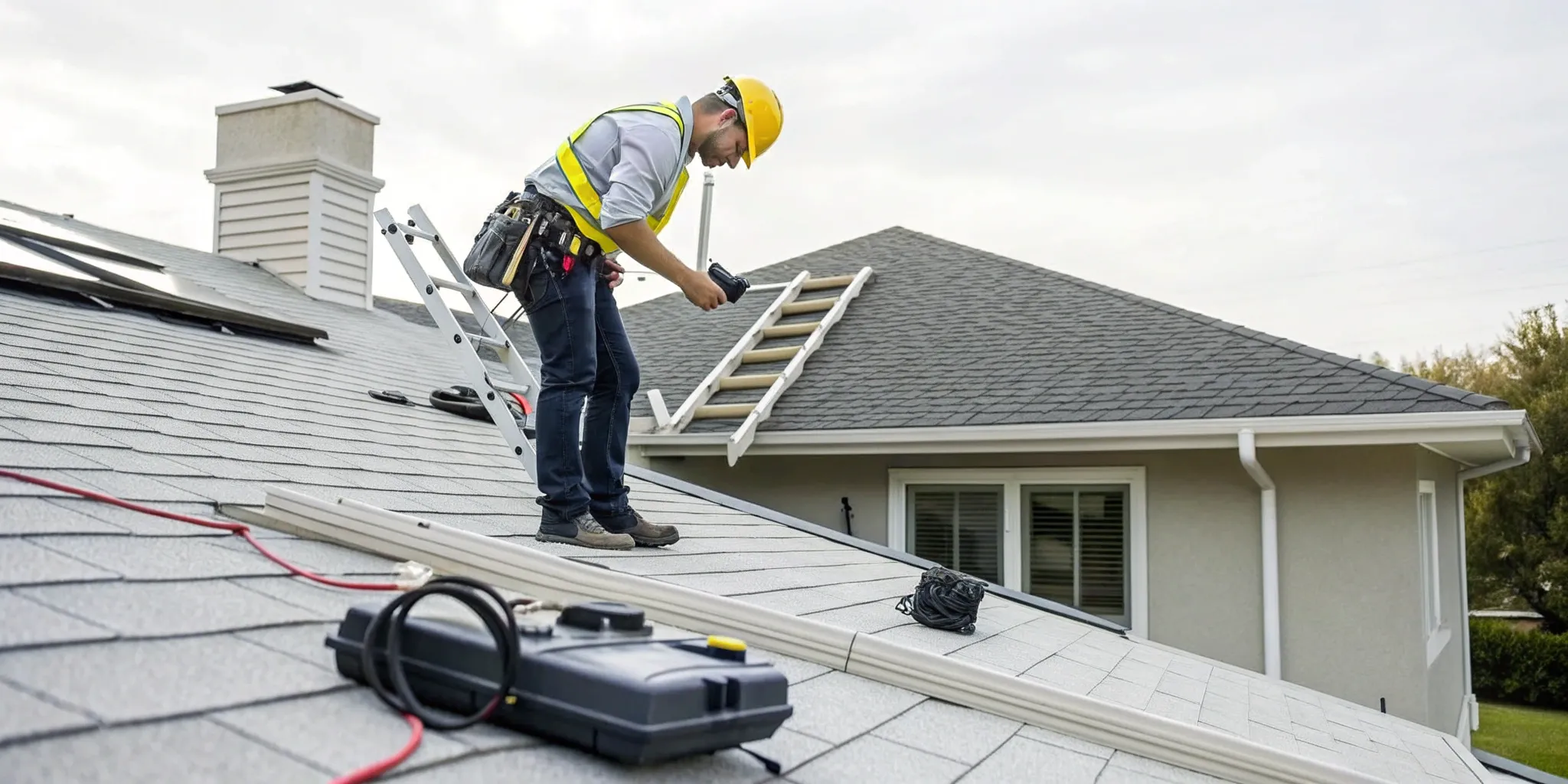
Two reasons, and the safety one comes ahead of the technical one. Roofs are slick, steep and sometimes structurally compromised in ways you cannot see from above. Falls from residential roofs cause serious injuries every year, and the equipment and training that reduce that risk are not things you own.
The technical reason is that water travels. It enters at a failed flashing joint, runs along a rafter for eight feet, soaks into insulation and appears on a ceiling in a different room. The stain is where the water gave up, not where it got in. Sealing the ceiling side of the problem, or applying roof cement to the nearest suspicious spot, traps moisture against wood and turns a repairable detail into rotted decking. Puncturing a bulging stained ceiling to relieve pressure is a common instinct and a genuinely dangerous one, because nobody knows how much water is sitting above it.
What a Professional Inspection Involves
The conversation before the ladder
A competent inspector starts by asking questions. When did you notice it, what was the weather doing, has it recurred, has anything been repaired or replaced up there, and do you have paperwork. This is not small talk. It narrows the search.
Interior and attic before rooftop
NRCIA members work through a LeakFREE® Check covering five zones: interior, attic, exterior, perimeter and rooftop. The attic is where the story usually is. Staining patterns on the underside of the sheathing show the travel path, and following it backward is how the entry point gets located rather than guessed at.
The roof surface and its weak points
Field condition, then every place the roof plane is interrupted. Flashing at chimneys, skylights, walls and valleys. Vent and pipe boots. Terminations, transitions, and the drainage path through gutters and downspouts. These interruptions are where residential leaks most commonly originate, and they are also where a cheap prior repair tends to show up.
Instruments for what the eye cannot see
Infrared cameras reveal temperature differences consistent with trapped moisture. Moisture meters confirm whether the anomaly is water or something else. These tools narrow the field. They do not replace someone physically examining the assembly, and an inspector who relies on the camera alone will find the wet insulation without ever establishing why it got wet.
The report
You should receive a written LeakFREE® Roof Inspection Report with dated photographs, a plain description of what was found, the likely source, and recommendations separated by urgency. It is a document you own. Take it to three contractors for bids.
What Affects the Price
Leak detection is a diagnostic service priced separately from any repair. Roof size, pitch, material, the number of penetrations and how accessible the suspected area is all move the figure. A hidden or intermittent leak takes longer than an obvious one and may require thermal or moisture equipment. Emergency dispatch outside normal hours costs more than a scheduled appointment, and when water is actively entering the house it is still usually the cheaper choice. Ask whether the diagnostic fee is credited against repair work, and get the answer before the visit rather than after.
How to Choose Who Comes Out
- Separate diagnosis from repair. An inspector who does not bid the fix has no financial stake in what they find.
- Verify insurance. General liability and workers compensation, with current certificates you actually look at.
- Check licensing where your state requires it. There is no federal license for roof inspectors, so requirements vary by jurisdiction.
- Ask about your roof type. Tile, metal, slate and low-slope membrane each fail differently from asphalt shingle.
- Ask what methods are included. Whether they get on the roof, whether they enter the attic, whether thermal imaging is part of the base price.
- Verify accreditation directly. A logo on a website is not verification.
Be wary of a price quoted over the phone by someone who has not seen the roof, pressure to sign during the visit, or anyone who tells you a full inspection is unnecessary.
What Usually Turns Out to Be the Cause
Failed flashing leads by a wide margin. Metal at chimneys, skylights, sidewalls and valleys rusts, loosens or was installed wrong to begin with. After that: cracked or displaced shingles and punctured or split low-slope membrane, deteriorated pipe boots, and clogged drainage that lets water back up under the roof edge. Some apparent leaks are not leaks at all. Poor attic ventilation lets warm moist air condense on the cold underside of the deck and drip, and that problem is solved by airflow, not by roofing.
What Happens After
Once the source is documented, repairs can be scoped accurately instead of by trial and error. Where a roof meets the published LeakFREE® criteria after repair, an accredited member can issue a LeakFREE® Roof Certification through InspectionPLUS®. That certification records that a specific roof, at a specific address, on a specific date, met those criteria, and it prints an expiration date set by the findings, the slope, the materials and the condition. It is a dated record of condition. It is not insurance and not a promise about the next storm. Re-inspection is triggered if repairs are later performed by anyone other than an NRCIA member.
Across 6,460 member inspections nationwide, more than 66 percent of roofs either qualified for a LeakFREE® certification or could be repaired to qualify. A leak is rarely the end of a roof. It is usually a detail that needed attention sooner than it got it.
Find an Accredited Inspector
Search the NRCIA member directory for an accredited inspector near you.
LeakFREE®, Forensic ROOF®, Mr. RoofCheck®, InspectionPLUS®, Today’s Inspection… Tomorrow’s Protection®, and Got Leaks?® are registered trademarks of Field Gate FLP, used by permission. RoofGUARD™, ForensicGUARD™, DisasterGUARD™, E3GUARD™, and Think Like a Raindrop™ are trademarks of Field Gate FLP.