
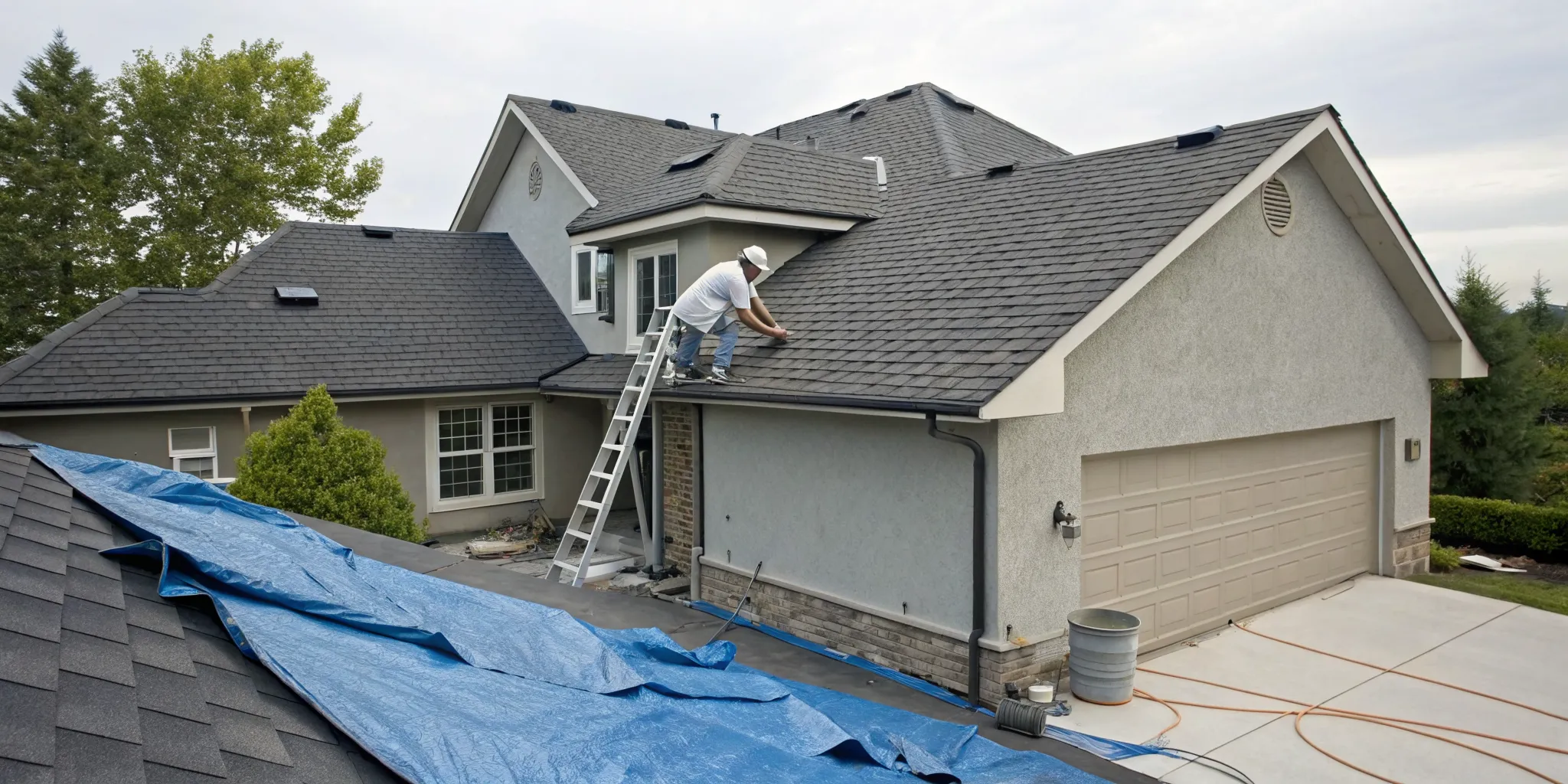
Start a roof leak repair by finding where the water got in
A stain on the ceiling means the roof has already been breached. Good roof leak repair begins with an honest answer to one question: where did the water actually enter? Almost never directly above the drip. Water runs along rafters, follows the seams in decking, soaks through insulation and then falls at the lowest point it can find, sometimes ten feet from the failure that let it in.
Patch the ceiling and you have treated a symptom. Trace the water back to its origin and you have something you can fix.
What usually causes the leak
A short list accounts for most residential leaks, across every region and nearly every roofing material.
- Failed flashing. The thin metal around chimneys, vent pipes, skylights and wall junctions corrodes, pulls loose or loses its sealant. Roof penetrations are where leaks tend to begin.
- Damaged or missing shingles. Wind lifts them, hail cracks them, age makes them brittle. One broken shingle can feed a slow leak for months before you see evidence inside.
- Clogged gutters. Water backs up along the roof edge, works under the covering and rots the decking from below.
- Age. Granules wash off, sealants dry and crack, and the assembly stops shedding water the way it did when it was new.
- Ponding on a low-slope roof. Standing water finds the weakest seam. Blisters in the membrane are a sign moisture is already trapped underneath.
That fourth cause matters to your wallet. Homeowners policies are generally written to pay for sudden, accidental damage. Deterioration and deferred maintenance usually fall outside coverage. Read your own policy language before you assume a claim will be paid.
Trace the source from the inside out
Pick a dry day. Take a strong flashlight into the attic and look at the underside of the roof deck and the rafters. You are hunting for dark staining, rust on nail shanks, mineral trails on wood, or mold. Follow the discoloration to its highest point. Water travels down, so the top of the stain sits closest to the entry.
Pay extra attention wherever something passes through the roof. Vents, pipes, chimneys, skylights. Once you have a general area, you can look at the matching spot on the exterior for cracked flashing, lifted shingles or a blocked gutter run above it.
Some leaks refuse to give up their source this way. Water can enter at a wall detail, a window head or a failed sidewall flashing and present exactly like a roof leak. That is the point at which guessing becomes expensive.
Safe temporary fixes while you wait
Temporary measures buy days, not seasons. Their job is to limit damage inside the house until a qualified contractor can make a lasting repair.
- Tarp the area. Use a heavy tarp that extends well past the damaged spot on every side and secure the edges so wind cannot get underneath.
- Seal a specific, visible crack. Waterproof repair tape or roofing cement on a clean, dry surface can hold a small gap around flashing or a vent for a short while.
- Catch the water inside. Put a bucket under the drip. If the ceiling is bulging, pierce the center of the bulge with a small nail so the trapped water drains in a controlled stream instead of bringing the drywall down.
About safety. Do not go onto a roof in rain, wind, ice or heat. Use a properly footed ladder, wear shoes with grip, and stop if you feel unsteady. No temporary patch is worth a fall. Plenty of homeowners should skip the roof entirely and work from the attic and the ground.
When to stop and call a professional
Certain findings mean the problem is bigger than a patch.
- Sagging or spongy decking, or a sagging ceiling. Saturated framing is a structural question, not a roofing question.
- Several leaks at once. Multiple entry points usually point to a systemic failure: widespread shingle loss, flashing installed wrong across the whole roof, or a covering at the end of its service life.
- A patch that failed. A leak that returns after a repair generally means the real entry point was never found.
- An aging roof with recurring leaks. At some point repeated repairs cost more than replacement. That is a math problem, and it needs real data about the remaining service life.
An NRCIA Certified Roof Inspector is trained to a national standard and performs a LeakFREE® Check across five zones: interior, attic, exterior, perimeter and rooftop. The finding lands in a LeakFREE® Roof Inspection Report you can hand to a contractor, an agent or a claims adjuster. There is no federal license for roof inspectors, so the accreditation behind the person on your roof is worth checking.
Document the damage before you repair it
If you intend to file a claim, build the record before anything gets fixed.
- Photograph widely and closely. The whole roof plane, then the specific missing shingles, dents, cracked flashing. Inside, capture every stain and every damaged belonging.
- Write down the date and time you noticed the leak and match it to the storm or event that preceded it.
- Get an independent inspection report. Adjusters look at the whole roof system, and a documented third-party assessment carries more weight than phone photos alone.
- Read your policy for roofing exclusions, coverage limits and your deductible before you call the carrier.
Be present when the adjuster visits, with your photos, your timeline and your report organized. Some owners ask their inspector to attend, which helps when technical questions come up.
What repairs tend to cost
Cost tracks the size of the failure, the location, the roofing material and how much water damage sits underneath. A few missing shingles or one cracked vent flashing is a modest repair. Rotted decking, saturated insulation and compromised framing is a different order of expense.
Labor carries much of the bill on any roof work, because access, safety and skill are most of the job. Get more than one written quote from accredited professionals, and make sure each quote describes the same scope. A repair priced against a guess is not a repair you can compare.
Preventing the next one
Have the roof inspected twice a year, in spring and fall, and again after any severe storm. Keep gutters clear. Trim branches that overhang the roof. Watch attic ventilation, which drives both summer heat load and winter ice damming.
Where a roof meets the published criteria, an accredited member can issue a LeakFREE® Roof Certification through InspectionPLUS®. It records that a specific roof at a specific address met those criteria on a specific date, and it carries a printed expiration date set by the findings, the slope, the materials and the condition, to a maximum of ten years. It is not insurance, and it is not a promise about future weather. It is documented evidence of condition, which is what a buyer, a carrier or a court actually asks for. LeakFREE® is our federally registered trademark. Only NRCIA members can issue a LeakFREE® certification.
Find an accredited inspector near you in the NRCIA member directory.
LeakFREE®, Forensic ROOF®, Mr. RoofCheck®, InspectionPLUS®, Today’s Inspection… Tomorrow’s Protection®, and Got Leaks?® are registered trademarks of Field Gate FLP, used by permission. RoofGUARD™, ForensicGUARD™, DisasterGUARD™, E3GUARD™, and Think Like a Raindrop™ are trademarks of Field Gate FLP.

