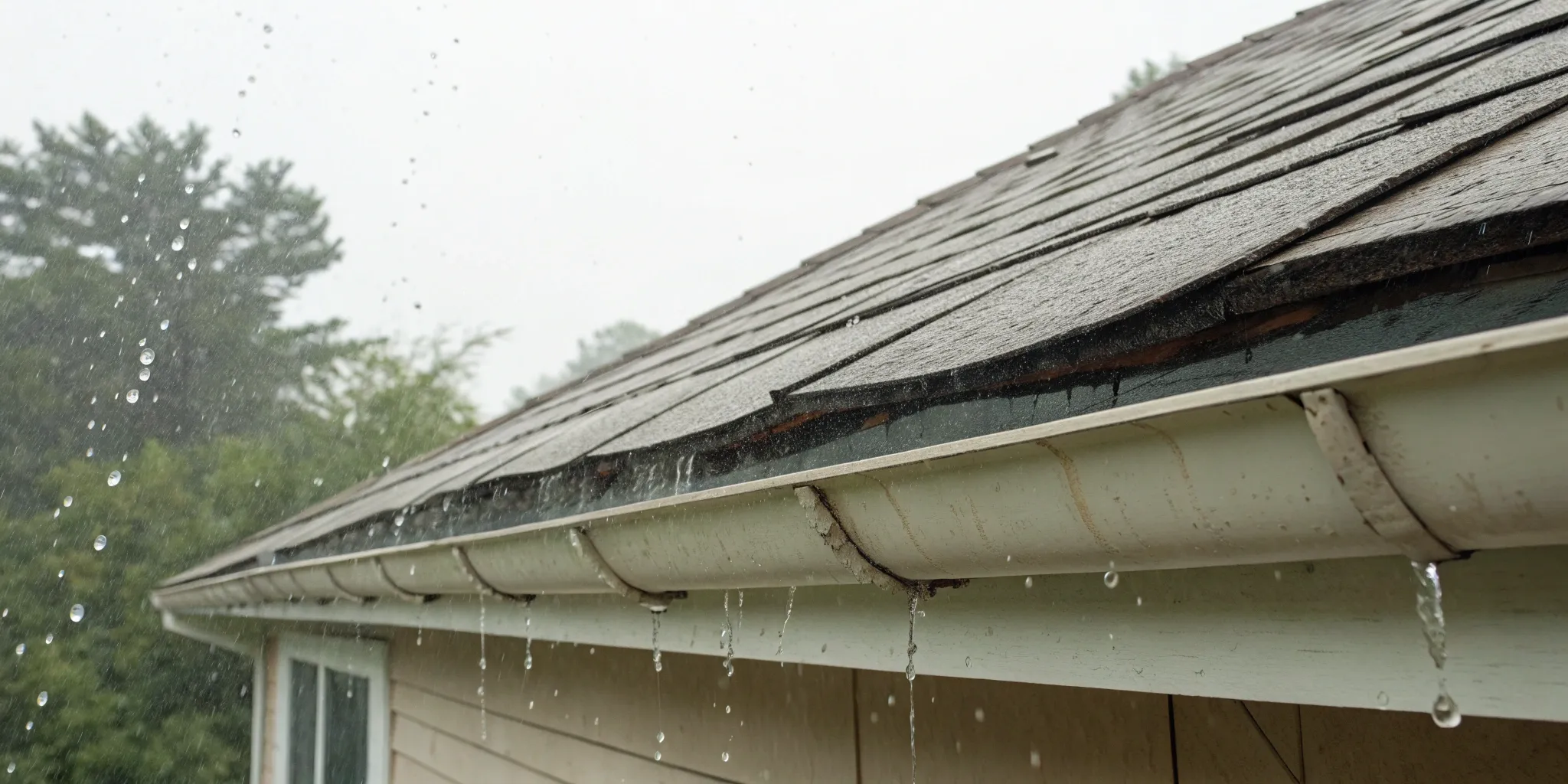
What causes a roof to leak: the short list
Ask a group of roof inspectors what causes a roof to leak and you will hear the same handful of answers. Water almost never comes through the middle of a healthy shingle field. It comes through the places where the roof is interrupted. A chimney. A vent pipe. A skylight, a valley, an edge. Those interruptions are sealed by small details that age faster than the material around them.
The second big category is time. Every roofing material has a service life. Once a roof passes it, the same storm that troubles nobody else on the street can put water in your attic.
Five sources behind most residential leaks
Failed flashing
Flashing is the thin metal that bridges the roof plane and a vertical surface: chimney sides, wall junctions, skylight curbs. Sealant dries out and shrinks. Metal corrodes. Thermal movement pulls a piece loose a fraction at a time until there is a gap. Flashing is where a great many documented leaks begin, and a poor flashing detail on a brand new roof will leak just as readily as one on a thirty-year-old roof.
Cracked pipe boots
Every plumbing vent through your roof wears a rubber or plastic collar. Sun cooks it. Given enough seasons the rubber goes brittle and splits, usually on the uphill side where you cannot see it from the ground. A boot is inexpensive to replace and expensive to ignore, because the water it lets in runs straight down the pipe and into a wall cavity.
Damaged or missing shingles
Wind lifts shingle tabs and breaks the sealant strip that holds them down. Hail bruises the mat. Foot traffic from a satellite installer cracks a course. A single missing shingle exposes the underlayment, which is a water-resistant layer, not a waterproof one. It buys you a season, not a decade.
Clogged gutters and ice dams
Gutters exist to move water away from the roof edge. Fill them with pine needles and the water backs up under the shingle course at the eave, soaks the decking and rots the fascia. In cold climates the same blockage builds an ice dam: attic heat melts snow, the melt refreezes at the cold overhang, and the ridge of ice pushes standing water back up under the roofing.
Age and granule loss
Asphalt shingles carry ceramic granules that shield the asphalt from ultraviolet light. As the roof ages, those granules release and collect at the bottom of your downspouts. Once the asphalt is bare it dries, shrinks and cracks. Most asphalt roofs are built for something in the range of twenty to twenty-five years, and the last few of those years are when leaks cluster.
Water travels before it shows
This is the part homeowners find maddening. Water enters at a nail hole, runs down the underside of the deck, follows a rafter across the attic and drips onto drywall well away from where it came in. A stain in a hallway ceiling can trace back to a chimney on the other side of the house. Patching the drywall accomplishes nothing. Patching the roof directly above the stain often accomplishes nothing either.
That is why an inspection follows the water backward. NRCIA members work a five-zone method under the LeakFREE® Check: interior, attic, exterior, perimeter and rooftop. The zones exist because the entry point and the evidence usually sit in different places.
Warning signs worth acting on
- Inside: brown rings on a ceiling, bubbling paint near a wall and ceiling joint, a musty smell upstairs after rain.
- In the attic: dark streaks on rafters, clumped or compressed insulation, daylight at a penetration, rusted nail shanks.
- Outside: curled or cupped shingle edges, granules piling at downspouts, flashing that has pulled away from a chimney, rust streaks on a wall below a roof joint.
Any of these deserves a look. A stain that grows after each rain deserves one this week.
Will homeowners insurance cover a roof leak?
Most policies separate sudden accidental damage from gradual deterioration. A tree limb through the deck or a documented hail event usually falls inside coverage. Twenty-year-old shingles that finally gave up usually do not, and carriers deny those claims as maintenance. Two details change your position: whether your policy pays replacement cost value or actual cash value, and whether you can show a maintenance record.
Dated inspection reports are that record. If a carrier argues the damage predates the storm, a report from an accredited inspector taken before the event is the cleanest answer available to you.
Preventing leaks before they start
Prevention is unglamorous and cheap. Clear the gutters twice a year, spring and fall. Trim branches that overhang the roof. After any severe wind or hail event, walk the perimeter and look up. Replace a cracked pipe boot the month you notice it rather than the season after.
Then schedule a professional look. The National Roofing Contractors Association recommends two inspections a year for most roofs. For a newer roof in a mild climate, once a year plus a check after major storms is a reasonable pace.
When to bring in an accredited inspector
Call a professional when a leak repeats after a repair, when your roof passes fifteen years, after a storm that damaged property nearby, or when you are buying or selling. An NRCIA Certified Roof Inspector is trained to a national standard, documents findings through InspectionPLUS®, and produces a LeakFREE® Roof Inspection Report you can hand to a carrier, an agent or a contractor.
If the roof meets the published criteria, the member can issue a LeakFREE® Roof Certification. That certification records the condition of a specific roof at a specific address on a specific date, with an expiration date printed on it. It is not insurance and it is not a service contract. It is evidence, which is what most homeowners actually need when a stain appears on a ceiling.
Find an accredited NRCIA inspector near you at the member directory.
LeakFREE®, Forensic ROOF®, Mr. RoofCheck®, InspectionPLUS®, Today’s Inspection… Tomorrow’s Protection®, and Got Leaks?® are registered trademarks of Field Gate FLP, used by permission. RoofGUARD™, ForensicGUARD™, DisasterGUARD™, E3GUARD™, and Think Like a Raindrop™ are trademarks of Field Gate FLP.