
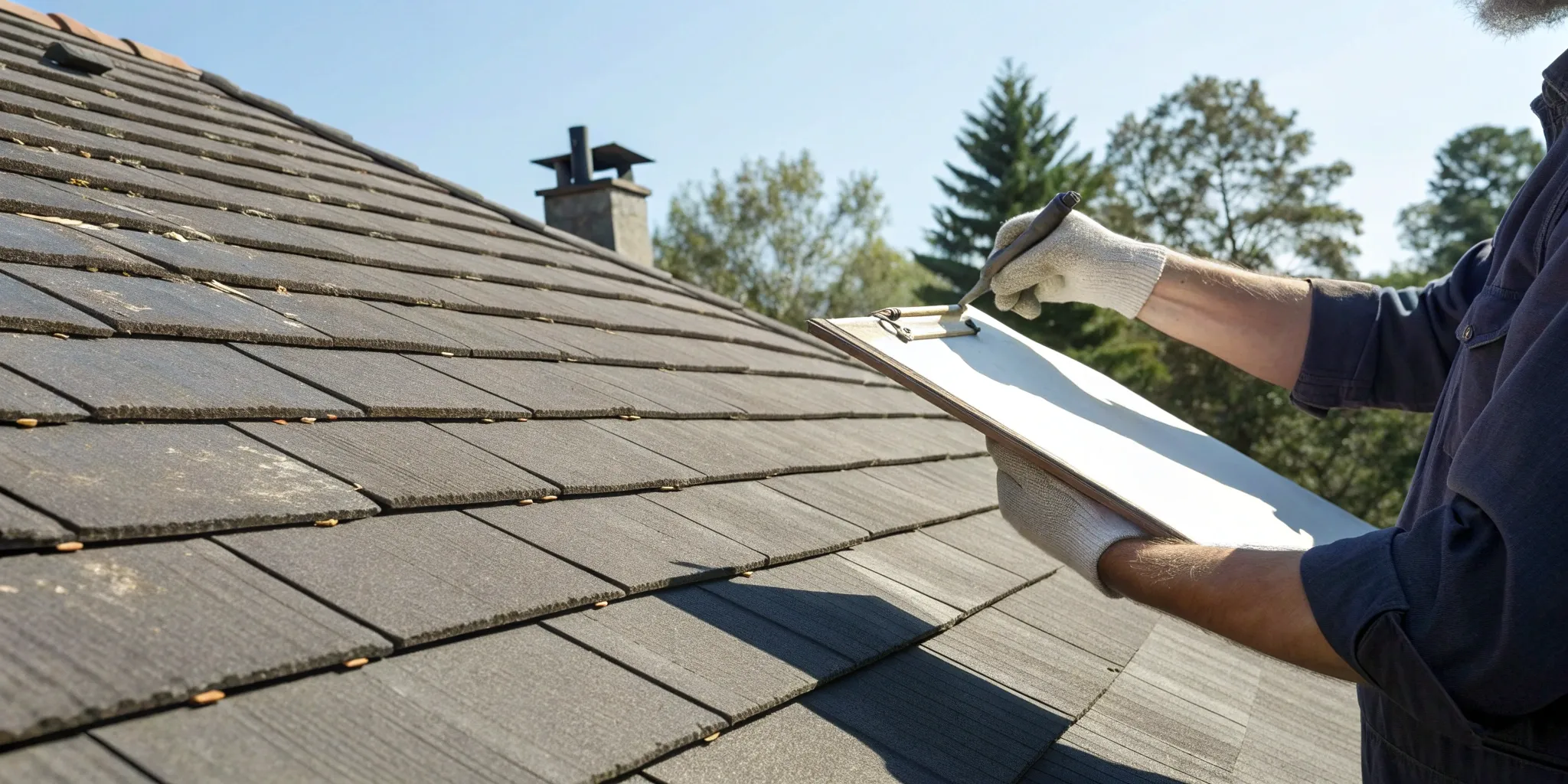
How to use a roof inspection checklist safely
A roof inspection checklist turns a vague glance into a repeatable record. Work it in the same order every time, note what you see, photograph anything that looks off, and date the file. Over a few years those files become a history of your roof, which is worth real money at sale time and during a claim.
Before anything else: stay off the roof. Most of what follows can be done from the ground with binoculars, from inside your attic, and from a ladder placed at the eave on level ground. Steep pitch, wet surfaces, frost, tile and slate are all reasons to stop and call someone trained to work at height. A fall costs more than an inspection.
Outside: work the perimeter
Walk the full perimeter of the building and look at each roof plane from two angles. Slow down at valleys, at ridges, and anywhere the roof meets a wall.
- Covering. Asphalt shingles: cracked, curled, lifted or missing pieces, bare patches, dark streaking, moss. Tile and slate: cracked, slipped or broken units. Metal: rust, dents, oil canning, panels or fasteners backing out. Low slope membrane: blisters, open seams, ponding that stays wet more than 48 hours after rain.
- Flashing and sealant. Flashing is the metal at every joint and transition, and it is where most leaks begin. Look for rust, lifted edges, separation from the wall, and sealant that has dried, shrunk or cracked away from the metal.
- Penetrations. Plumbing vent boots crack and split with age, usually on the sun side. Check the seal at chimneys, exhaust vents, satellite mounts and solar standoffs. Look at chimney mortar for crumbling joints.
- Skylights. Cracked glazing, failed seals showing as fog between panes, staining on the interior frame.
- Edges. Fascia and soffit for peeling paint, soft wood or stains. Drip edge present and tight.
- Gutters and downspouts. Clear, pitched, firmly attached, discharging away from the foundation. A heavy layer of shingle granules in the gutter is a sign the covering is aging out.
Inside: the attic tells the truth
The attic is where a roof problem announces itself long before a ceiling stain does. Bring a flashlight, and pick a dry day so you can tell old staining from active leaking.
- Turn off the lights and look for daylight through the deck or at penetrations.
- Check the underside of the sheathing for dark staining, water tracks, mold growth or delamination.
- Feel the insulation. Damp or matted insulation means water is getting in, or the space is not breathing.
- Look at nail points. Rusted nails or frost on nail tips point to a ventilation problem.
- Confirm soffit vents are not blocked by insulation and that ridge or gable venting is open. Bath and kitchen fans should vent outside, never into the attic.
- Check framing for sagging, cracked rafters or truss repairs done with scrap lumber.
Then walk the top floor. Yellow or brown ceiling stains, bubbling paint, soft drywall, a musty smell in a closet on an exterior wall: all of it reads back to the roof until proven otherwise.
When to run the checklist
Twice a year is the working rhythm for most properties, in spring and in fall, plus a check after any hail, high wind or heavy snow event. Roofs past ten years old earn the twice yearly schedule regardless of climate, because sealants harden, fasteners loosen and materials get brittle with age.
Spring is for damage assessment. Look for what winter lifted, cracked or loaded. Clear the gutters of what fell in over the winter.
Fall is for preparation. Clear leaves before they pack into ice dams, check seals that will contract in the cold, and secure anything loose before the wind finds it.
After a storm, check from the ground as soon as it is safe. Missing or displaced pieces, dented vents and gutters, and fresh debris on the roof are all worth documenting the same day, with photographs, if a claim may follow.
Mistakes that make a checklist useless
Three habits undo an otherwise good inspection.
Assuming a dry ceiling means a healthy roof. Granule loss, split boots, failed flashing and blocked ventilation all cause damage for months or years before a drop of water reaches a ceiling. By the time it does, the sheathing is often the problem, not the shingles.
Climbing when you should not. Wet, steep, brittle or unfamiliar means someone else goes up.
Not writing it down. A finding you did not photograph and date is a memory, and memories do not support insurance claims or disclosure documents.
What a certified roof inspector adds
A homeowner checklist catches the visible. A trained inspector catches the rest, and produces a document other people will accept.
NRCIA has set the national standard for roof inspection and certification since 1995. NRCIA does not inspect roofs. Accredited members do. A member performs a LeakFREE® Check across five zones, interior, attic, exterior, perimeter and rooftop, and issues a LeakFREE® Roof Inspection Report generated through InspectionPLUS®.
Where a roof meets the published criteria, the member can issue a LeakFREE® Roof Certification. It records that a specific roof, at a specific address, on a specific date, met those criteria, with a term set by the findings, the slope, the materials and the condition, up to ten years. It does not promise that a roof will never leak, and it is not insurance. What it does provide is a dated, third party record that a buyer, an agent or a carrier can rely on. Across 6,460 member inspections nationwide, more than 66 percent of roofs either qualified for a LeakFREE® certification or could be repaired to qualify.
LeakFREE® is our federally registered trademark. Only NRCIA members can issue a LeakFREE® certification.
Get a trained set of eyes on it
Find an accredited NRCIA inspector near you.
LeakFREE®, Forensic ROOF®, Mr. RoofCheck®, InspectionPLUS®, Today’s Inspection… Tomorrow’s Protection®, and Got Leaks?® are registered trademarks of Field Gate FLP, used by permission. RoofGUARD™, ForensicGUARD™, DisasterGUARD™, E3GUARD™, and Think Like a Raindrop™ are trademarks of Field Gate FLP.

