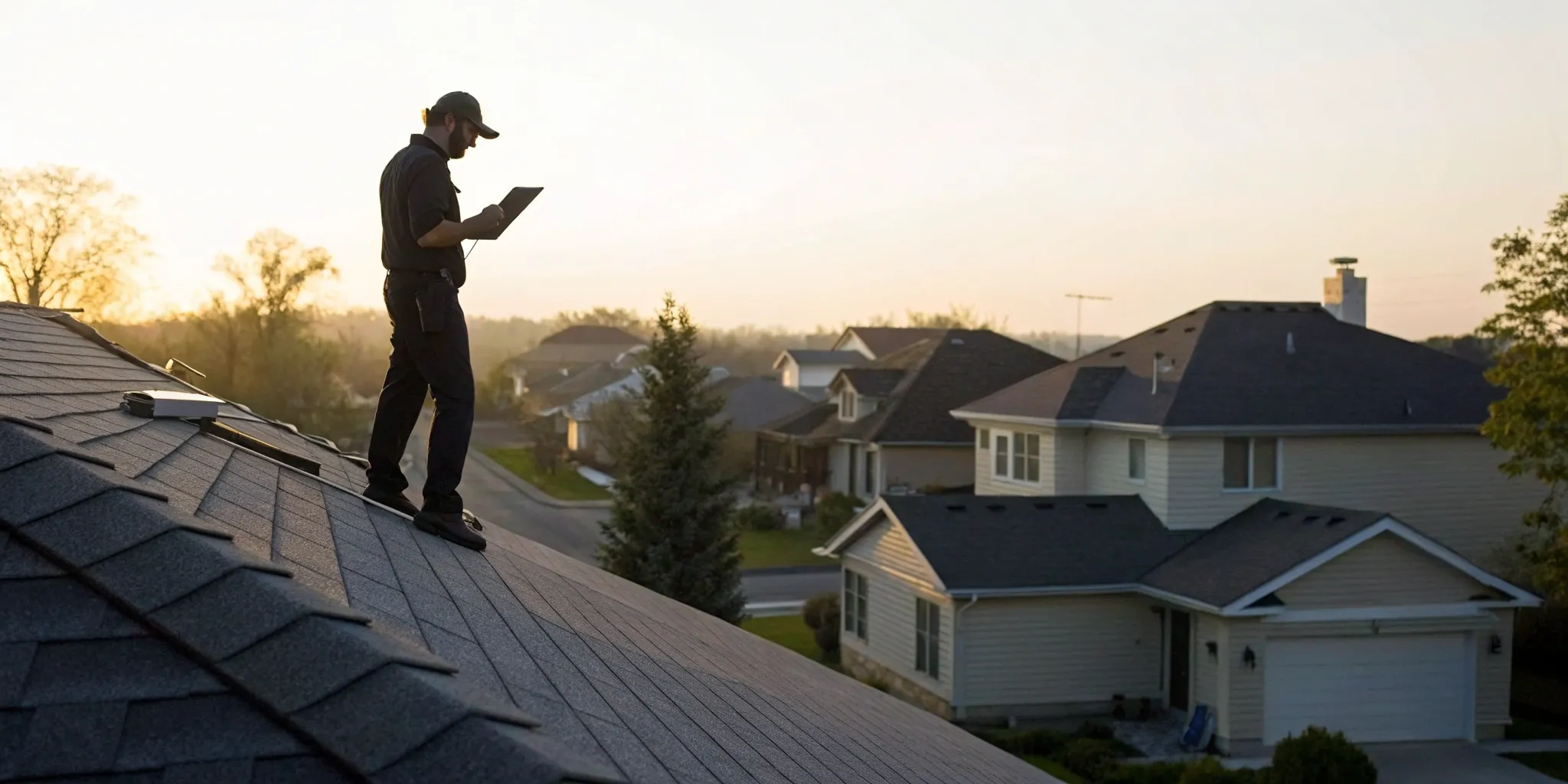
What the job is
A roof inspector evaluates a roof and records what is there. No repair bid. No stake in the work that follows. That independence is the product a homeowner, an agent, an attorney or an adjuster is paying for, and it shapes every part of the roof inspector job description below.
The work sits between construction and documentation. You need enough building knowledge to read an assembly, and enough discipline to write down what you saw rather than what you assume.
The roof inspector job description, hour by hour
Before the ladder
Confirm access, roof type, approximate age, and the reason for the visit. A pre-listing inspection, a post-storm assessment and a dispute headed for litigation each need different documentation. Knowing which one you are on before you arrive changes what you photograph.
On the property
Members trained to the NRCIA standard perform the LeakFREE® Check, a multi-zone inspection across five zones. Interior ceilings and walls carry the staining history. The attic shows the underside of the deck, the ventilation and the insulation. The exterior and the perimeter show wall-to-roof transitions, drainage and grade. The rooftop shows the field, the flashing, the penetrations and the edge metal.
Most of a working day covers two to four properties, depending on size and travel. Steep-slope residential moves faster than a multi-building commercial portfolio.
Back at the desk
Photographs, measurements and field notes become the LeakFREE® Roof Inspection Report. Every finding gets an image. Every recommendation gets a reason. The report is the piece of your work that outlives the visit, and in a claim or a lawsuit it is the piece that gets read closely.
Skills the work actually demands
- Pattern recognition. Hairline cracks in a mortar bed, a lifted shingle tab, granule loss concentrated below a valley. The signal is usually small.
- Building science. Water moves by gravity, capillary action, wind pressure and vapor drive. An inspector who understands all four finds the source instead of the symptom.
- Plain writing. A homeowner and an attorney both have to understand the report on one read.
- Client conversation. You will deliver bad news to someone who just made an offer on a house. Be direct and be kind.
- Physical capability. Ladders, pitch, heat, wind. Fall protection is not optional, and neither is knowing when a roof is too wet or too brittle to walk.
- Technology. Drones for steep or fragile assemblies, moisture meters, infrared where conditions support it, and reporting software that produces a consistent document every time.
Licensing and accreditation
There is no federal license for roof inspectors. State requirements vary, and across much of the country nothing prevents an untrained person from using the title. That gap is precisely why accreditation carries weight with the people who hire you.
NRCIA sets the standard and accredits the professionals who work to it. The RoofGUARD™ program leads to the NRCIA Certified Roof Inspector designation, advancing to Senior at 500 inspections and Master at 1,000. ForensicGUARD™ is the flagship program, built for cause-and-origin work and expert testimony. E3GUARD™ covers exterior elevated elements, meaning decks, balconies, walkways, patios and staircases, with state tracks including CA-SB721 and CA-SB326. DisasterGUARD™ adds insurance-related evaluation work on top of an active ForensicGUARD or E3GUARD accreditation.
What determines pay
Published wage data groups roof inspection inside the broader construction and building inspector category rather than reporting it separately, so a single national figure will not describe your market. These are the drivers that do:
- Region and weather. Hail and wind corridors generate volume that mild climates do not.
- Property type. Multifamily, commercial and portfolio work pays differently than single-family transactions.
- Employment structure. Salaried inspection staff, an agency role and an owner-operator practice all earn on different curves.
- Specialty. Forensic and expert-witness work, insurance evaluations and exterior elevated element compliance command different rates than routine condition reports.
- Repeat referral. Agents, property managers and home inspectors who send steady work are worth more than any single job.
California adds a durable source of scheduled work. SB 721 covers rental buildings of three or more units, its initial inspection deadline passed on January 1, 2026, and it repeats every six years. SB 326 covers condominium and HOA associations, its deadline passed on January 1, 2025, and it repeats every nine years. Those cycles keep coming around.
How the job starts
Most people arrive from roofing, construction, engineering or home inspection. None of those backgrounds is required. What the work rewards is a methodical process, applied the same way on every roof, documented well enough that someone else can follow your reasoning a year later.
Review the RoofGUARD program and start accreditation
LeakFREE®, Forensic ROOF®, Mr. RoofCheck®, InspectionPLUS®, Today’s Inspection… Tomorrow’s Protection®, and Got Leaks?® are registered trademarks of Field Gate FLP, used by permission. RoofGUARD™, ForensicGUARD™, DisasterGUARD™, E3GUARD™, and Think Like a Raindrop™ are trademarks of Field Gate FLP.