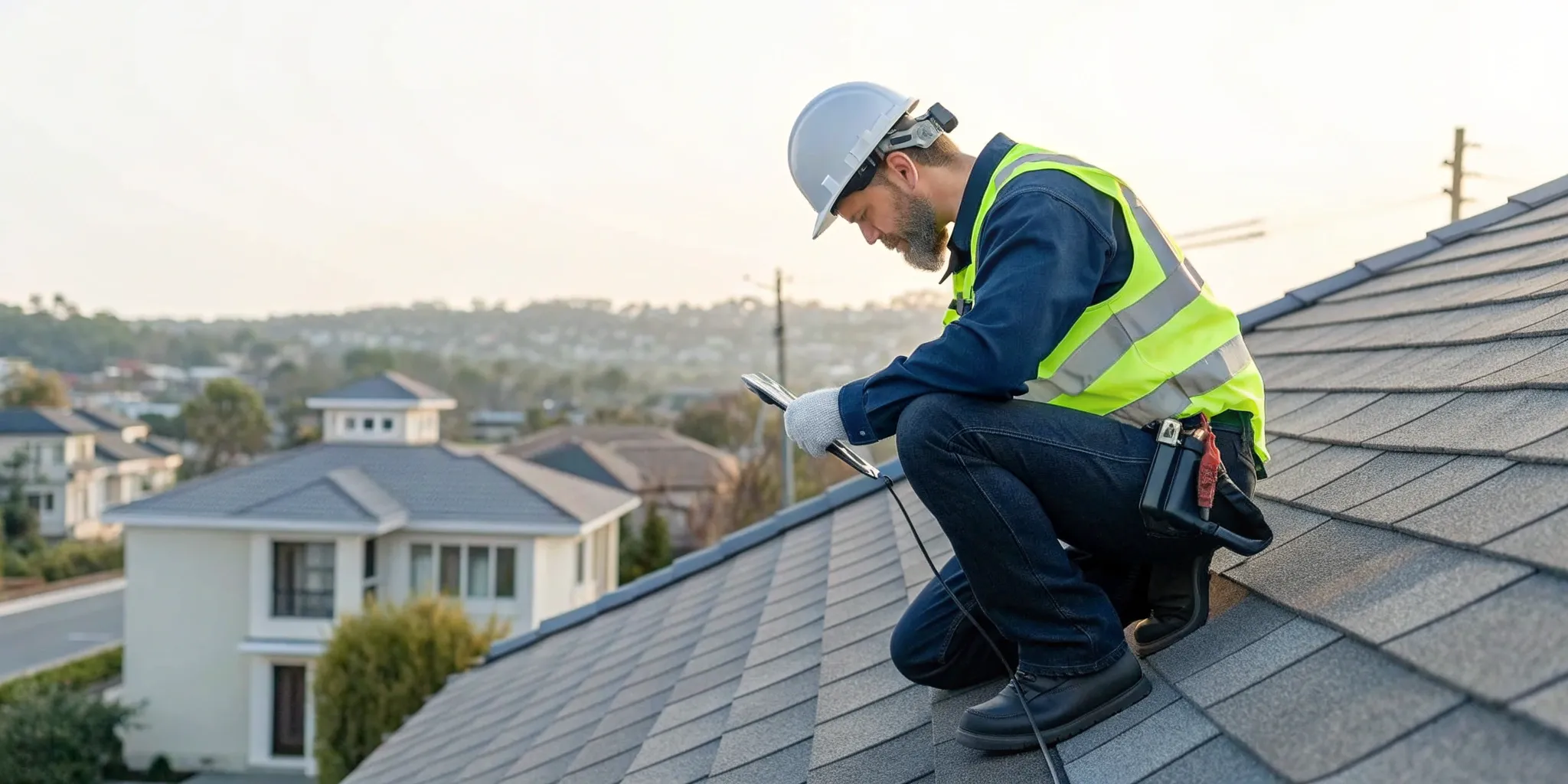
What a certified roof inspector does, and what California requires
Becoming a certified roof inspector in California takes less licensing than most people assume, and that cuts both ways. There is no federal license for roof inspectors. California does not license roof inspection as a standalone trade either. Your credibility comes from your training, your documentation, and the standard you work to.
Where state law does bite: if you offer to perform the repairs you recommend, you are performing contracting work, and that falls under the California Contractors State License Board. Inspecting and repairing are two businesses. Decide which one you are in, and get the license the second one requires before you quote a repair.
The background that actually helps
No degree is required. A high school diploma or GED is the usual baseline. What moves you faster is time on roofs.
Roofing or construction experience means you already know how a system is assembled, which tells you where it will fail. If you are coming in cold, spend a season with a roofing company or shadow a working inspector before you charge anyone. Reading a roof is a pattern-recognition skill, and patterns take repetitions.
The job is physical. You will be on ladders, on slopes, in attics, in heat. Plan for that honestly.
Choosing an accreditation path
NRCIA
NRCIA has set the roof inspection standard since 1995 and trains and accredits members to apply it. The RoofGUARD™ program leads to the NRCIA Certified Roof Inspector designation. The path runs through the training, a practice inspection, and a review with an instructor.
Two further programs matter in California. ForensicGUARD™ is the flagship, covering forensic and expert witness work. E3GUARD™ covers exterior elevated elements, meaning decks, balconies, walkways, patios and staircases, with the CA-SB721 track. E3GUARD has no prerequisite program, so it is open to you early.
InterNACHI
A home inspector association with a broad online library. Roof inspection sits inside its general home inspector framework, and members work at their own pace. A reasonable fit if you intend to do whole-home inspection with roofs as one component.
HAAG Engineering
An engineering-based program focused on damage assessment for hail and wind, delivered as a multi-day course with an annual renewal. It is aimed at established professionals adding a damage specialty.
These serve different ends. Pick against the work you intend to sell, not against the shortest syllabus.
The balcony work, and who is actually qualified
California balcony inspection is real, recurring demand, and it is also where new inspectors most often get bad advice. The statutes limit who may perform these inspections.
SB 721 applies to rental buildings with three or more units. The initial inspection deadline was January 1, 2026, and it has passed, so the market now is compliance catch-up and the six-year re-inspection cycle. The statute recognizes a licensed architect, a civil or structural engineer, a contractor holding an A, B or C-5 license with a minimum of five years of multistory wood-frame experience, or a certified building inspector.
SB 326 applies to condominium and HOA properties. Its deadline was January 1, 2025, and the re-inspection cycle is nine years. Civil Code 5551 sets a narrower professional pool than SB 721 does.
Penalties are commonly cited at 100 to 500 dollars per day, plus a possible building safety lien, which is why property managers and HOA boards move on this when they are shown the exposure.
Check your own qualification against the statute before you market these services. If you do not yet hold a qualifying credential, E3GUARD training still builds the technical competence, and the compliance work gives you a reason to be in front of property managers who also need roofs looked at.
Tools and insurance
Your kit starts small: a rated ladder, a harness and anchor for steep work, slip-resistant boots, gloves, a tape, chalk, binoculars for the ground pass, and a camera you trust. A phone camera is fine if you know how to use it. Drone and infrared imaging come later, and they extend what you can document rather than replacing what you walk.
Carry general liability. Carry errors and omissions, because an inspection is a professional opinion in writing and E&O is what stands behind that opinion. Confirm your city and county business registration before you take work.
The report is the product
Finding the defect is half the job. The other half is a document a homeowner, an agent, an adjuster or an attorney can read without you in the room.
NRCIA members perform a LeakFREE® Check across five zones: interior, attic, exterior, perimeter and rooftop. The findings go into a LeakFREE Roof Inspection Report. Where the roof meets the published criteria, the accredited individual who performed the inspection issues a LeakFREE Roof Certification through InspectionPLUS®. A certificate generated outside that platform is not valid, and no business entity can issue one in place of the accredited person.
Be precise with clients about what that certificate is. It records the condition of a specific roof, at a specific address, on a specific date, for a term set by the findings, the slope, the materials and the condition, to a maximum of ten years. It is not insurance and not a service contract. Terms are never stretched to close a sale. Selling it as anything more is how inspectors end up in a deposition.
Across 6,460 member inspections, more than 66 percent of roofs either qualified for a LeakFREE certification or could be repaired to qualify. Most of your work will be documenting sound roofs and repairable ones, which is a better business than people expect.
Building the book of business
Referral sources decide your calendar. Real estate agents, property managers, HOA boards, insurance agents and roofing contractors all need someone they can send a client to and not worry about it.
Show up on time, write clearly, photograph everything, and say what you do not know. LeakFREE is our federally registered trademark, and only NRCIA members can issue a LeakFREE certification, so accreditation gives you something specific to offer that a general home inspector cannot.
Each NRCIA program is an annual membership, so you can start with the program that fits the work your business does today.
Review the RoofGUARD program and start your accreditation.
LeakFREE®, Forensic ROOF®, Mr. RoofCheck®, InspectionPLUS®, Today’s Inspection… Tomorrow’s Protection®, and Got Leaks?® are registered trademarks of Field Gate FLP, used by permission. RoofGUARD™, ForensicGUARD™, DisasterGUARD™, E3GUARD™, and Think Like a Raindrop™ are trademarks of Field Gate FLP.