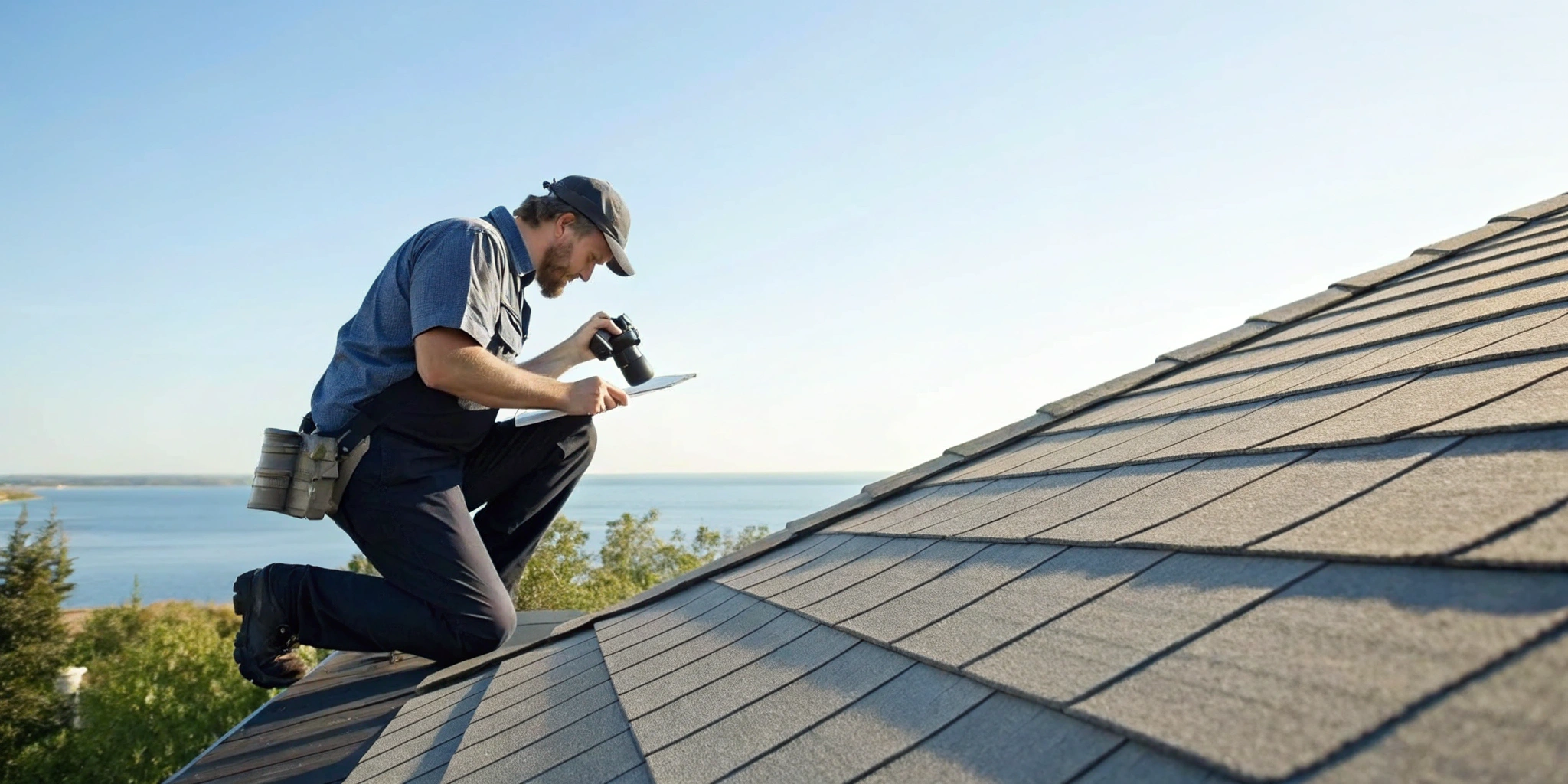
What online roof inspector training gives you
Online roof inspector training teaches you to evaluate a roof systematically and write up what you found so someone else can act on it. That is the whole job. Anyone with a ladder can report a missing shingle. A trained inspector explains why it failed, what the failure suggests about the rest of the system, and what the owner should do about it in what order.
The format is usually self-paced video and reading, with quizzes along the way and a graded exam at the end. What separates programs is not delivery. It is what they require of you before they put a credential behind your name.
The skills a program has to build
- Inspection technique across asphalt shingle, wood, tile, metal, slate and low-slope membrane systems, because each one fails differently.
- Damage recognition: wind, hail, foot traffic, installation defect, ponding, thermal movement and simple age.
- Safety at height. Ladder setup, fall protection, roof-access judgment, and knowing which roofs you do not walk.
- Building codes and manufacturer installation requirements, so you can say whether a roof was installed to standard.
- Report writing and photo documentation that a claims adjuster or an attorney can follow without calling you.
The programs worth comparing
Several organizations train inspectors online, each aimed at a different corner of the work:
- NRCIA. A national standards body for roof inspection and certification, founded in 1995 to bring a consistent inspection process to a trade that had none. Accredits individual inspectors and administers the LeakFREE® certification system.
- InterNACHI. Home inspection curriculum with roof modules, generally included in membership. A reasonable base for residential generalists.
- NRCA. Contractor-focused education. Strong on how roofs are built, which is useful background for judging how they fail.
- HAAG. Intensive, science-based storm damage analysis, widely recognized in insurance and legal work.
- CCPIA. Commercial and low-slope training for inspectors moving beyond single-family housing.
Fees, renewal cycles and prerequisites differ by organization, so confirm the current figures directly with each. Renewal is normal and expected. Every credible credential expires and requires continuing education to stay active.
Where NRCIA accreditation sits
NRCIA does not perform inspections. We set the standard, train and accredit members, administer the certification system, and maintain the member directory that homeowners, agents and insurers search. Members do the field work and sign the reports.
Membership pairs a program, which is the training accreditation, with a package: Silver, Gold, Platinum or Enterprise.
- RoofGUARD™ earns the NRCIA Certified Roof Inspector (CRI) designation, advancing to Senior (SRI) at 500 inspections and Master (MRI) at 1,000.
- ForensicGUARD™ earns the NRCIA Forensic Roof Inspector (FRI) designation. Cause and origin work, litigation-grade documentation, expert witness testimony.
- E3GUARD™ covers exterior elevated elements, meaning decks, balconies, walkways, patios and staircases. No prerequisite program, with state tracks including CA-SB721 and CA-SB326.
- DisasterGUARD™ adds insurance-related evaluation work to an active ForensicGUARD™ accreditation, or to E3GUARD™ for members already handling disaster claims.
The inspection itself is a LeakFREE® Check covering five zones: interior, attic, exterior, perimeter and rooftop. The deliverable is a LeakFREE® Roof Inspection Report. Where the roof meets the published criteria, the accredited individual who performed the inspection can issue a LeakFREE® Roof Certification through InspectionPLUS®.
LeakFREE® is our federally registered trademark. Only NRCIA members can issue a LeakFREE® certification.
Describe it accurately to clients. The certification records that a specific roof at a specific address met the criteria on a specific date, for a term set by findings, slope, materials and condition, capped at ten years. It is not insurance, not a service contract, and not a promise that the roof will never leak. Repairs performed by anyone outside NRCIA membership trigger a re-inspection.
How to choose your program
Start with the client you want. Transaction work rewards speed, clarity and a report an agent can forward. Insurance work rewards defensible cause-and-effect documentation. Commercial work rewards low-slope knowledge and access to a portfolio manager. The credential should match the buyer.
Then check the practical details before you pay: prerequisites, exam format, retake policy, whether field work is required, what software or reporting platform comes with it, and what renewal costs in time and continuing education.
There is no federal license for roof inspectors. That absence is why the credential you choose carries so much weight with the people who read your reports.
After the exam
The certificate is the starting line. Field volume is what turns training into judgment, so take the work that gets you on roofs: shadow an experienced inspector, take entry-level assignments, inspect everything you can reach safely.
Field data gives you a useful frame for those early conversations. Across 6,460 member inspections nationwide, more than 66 percent of roofs either qualified for a LeakFREE® certification or could be repaired to qualify. Most roofs are not replacement candidates, and homeowners rarely hear that from anyone selling a roof.
Keep learning after you are accredited. Materials change, codes change, and the inspector whose knowledge stopped at the exam gets found out in a deposition.
Start your accreditation
Review the RoofGUARD™ program and begin accreditation at nrcia.org/programs/roofguard/. If your work is already heading toward claims and disputes, compare it with ForensicGUARD™ before you enroll.
LeakFREE®, Forensic ROOF®, Mr. RoofCheck®, InspectionPLUS®, Today’s Inspection… Tomorrow’s Protection®, and Got Leaks?® are registered trademarks of Field Gate FLP, used by permission. RoofGUARD™, ForensicGUARD™, DisasterGUARD™, E3GUARD™, and Think Like a Raindrop™ are trademarks of Field Gate FLP.