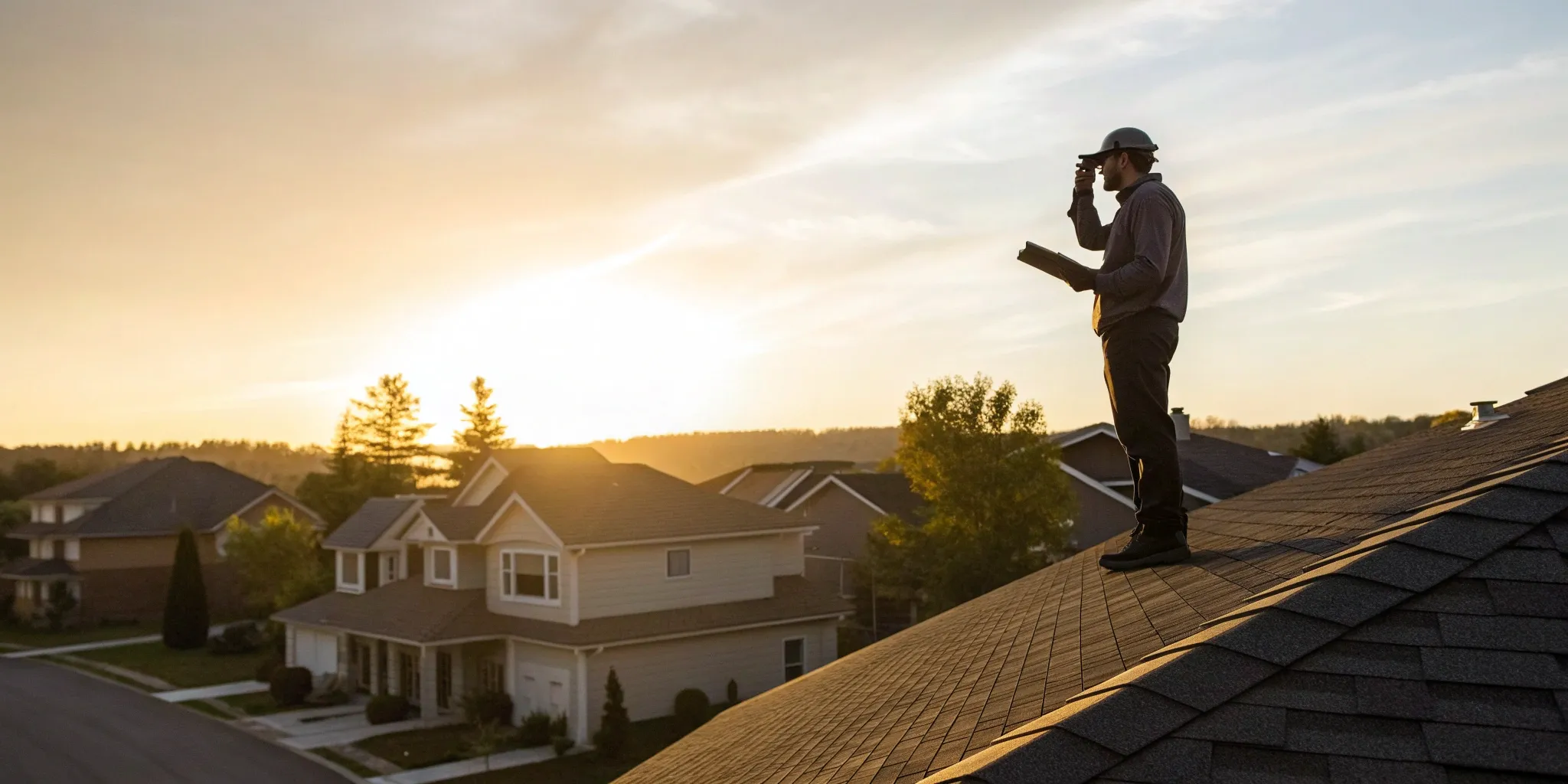
What the job actually involves
If you are working out how to become a roof inspector, start with an honest picture of the work. A roof inspector evaluates a roof system and puts the findings in writing for someone who will make a decision based on them: a buyer, a seller, an agent, an adjuster, a property manager or an attorney. The climbing is the easy part. The judgment and the documentation are the job.
A typical week mixes real estate transactions, post-storm assessments, maintenance evaluations and new construction checks. You will assess structure, materials, flashing, penetrations, drainage and ventilation, then write it all up with photographs attached to each finding. Some days you will spend more time at a keyboard than on a ladder.
What you need before you start
Background
A four-year degree is not required. A high school diploma is the usual baseline. Time in roofing, framing or general construction is a genuine advantage, because you have already seen how these systems fail. What you will need to add is building code familiarity, material knowledge across systems you have not personally installed, and a documented method.
Skills that separate good inspectors from adequate ones
Attention to small signals: a granule pile in a downspout, a nail pop pattern, a flashing joint that was caulked instead of flashed. Diagnostic reasoning, because water rarely enters where it appears. And plain writing. You will explain a technical failure to an anxious homeowner and to an adjuster in the same afternoon, and both need to understand you on one read.
Physical readiness and safety
You will climb ladders repeatedly, walk slopes in varied weather, and make judgment calls about which roofs should not be walked at all. Knowing when to use a drone or a pole camera instead of your boots is a professional skill, not a shortcut. Personal fall protection is not optional equipment.
Licensing
There is no federal license for roof inspectors. That surprises most people who enter the field. Requirements sit with states and sometimes with municipalities, and they vary widely: some states cover it under contractor licensing, some under home inspector licensing, some not at all. Check your state licensing board before you take a paid job, and check again if you cross a state line to work.
Because the licensing picture is uneven, accreditation carries more weight here than it does in trades with a single national credential. It is how a client tells one inspector from another.
How to become a roof inspector through NRCIA accreditation
NRCIA has set the standard for roof inspection and certification since 1995. Membership combines a Program, which is the training accreditation you earn, with a Package, which is your annual benefits: Silver, Gold, Platinum or Enterprise.
- RoofGUARD™ is the residential and commercial inspection accreditation. You earn the designation NRCIA Certified Roof Inspector (CRI), advance to Senior Roof Inspector (SRI) at 500 inspections, and to Master Roof Inspector (MRI) at 1,000.
- ForensicGUARD™ is the flagship program, for failure analysis, litigation support and expert witness work. Designations run FRI, SFRI and MFRI.
- E3GUARD™ covers exterior elevated elements: decks, balconies, walkways, patios and staircases. It has state tracks including CA-SB721 and CA-SB326, and no prerequisite program.
- DisasterGUARD™ covers insurance-related evaluations. It is an add-on requiring an active ForensicGUARD™ accreditation, or E3GUARD™ for members already doing disaster work.
Training is delivered online at your own pace and is followed by a practice inspection and an accreditation review. Accredited members inspect roofs to the LeakFREE® Check, which covers five zones: interior, attic, exterior, perimeter and rooftop. Members issue the LeakFREE® Roof Inspection Report, and where the roof meets the published criteria, the LeakFREE® Roof Certification, generated and registered through InspectionPLUS®.
LeakFREE® is our federally registered trademark. Only NRCIA members can issue a LeakFREE® certification.
Across 6,460 member inspections nationwide, more than 66 percent of roofs either qualified for a LeakFREE® certification or could be repaired to qualify. That number tells you something about the shape of the work: most of your findings will be repairable, and your value is in identifying them precisely.
Building experience that holds up
Accreditation gives you the method. Volume gives you the pattern recognition. Shadow an experienced inspector if you can, even for a handful of jobs, and watch how they sequence a walk and how they talk to a nervous client. Take work from a home inspection firm or a roofing company early if independent volume is slow. Every inspection you document well becomes a reference for the next one.
Keep a personal log of unusual failures. Tile underlayment that failed in twelve years. A parapet that funneled water into a wall cavity. Those cases are what let you speak with confidence later, particularly if you move toward forensic work.
Turning accreditation into a business
Get the administrative side settled before you chase clients. That means the licenses your state requires, general liability coverage, and errors and omissions coverage, which protects you when a finding is disputed. Set up your reporting and scheduling before your calendar fills, not after.
Then build referral relationships with the people who need inspections repeatedly: real estate agents, insurance agents, property managers and roofing contractors. Accredited members appear in the NRCIA member directory, which sends inbound work from people already searching for a standard rather than a price.
Specialization is where the income curve bends. Exterior elevated elements compliance, forensic work and insurance evaluations all command more because fewer people can do them properly.
Start here
Review the RoofGUARD™ program and begin accreditation.
LeakFREE®, Forensic ROOF®, Mr. RoofCheck®, InspectionPLUS®, Today’s Inspection… Tomorrow’s Protection®, and Got Leaks?® are registered trademarks of Field Gate FLP, used by permission. RoofGUARD™, ForensicGUARD™, DisasterGUARD™, E3GUARD™, and Think Like a Raindrop™ are trademarks of Field Gate FLP.