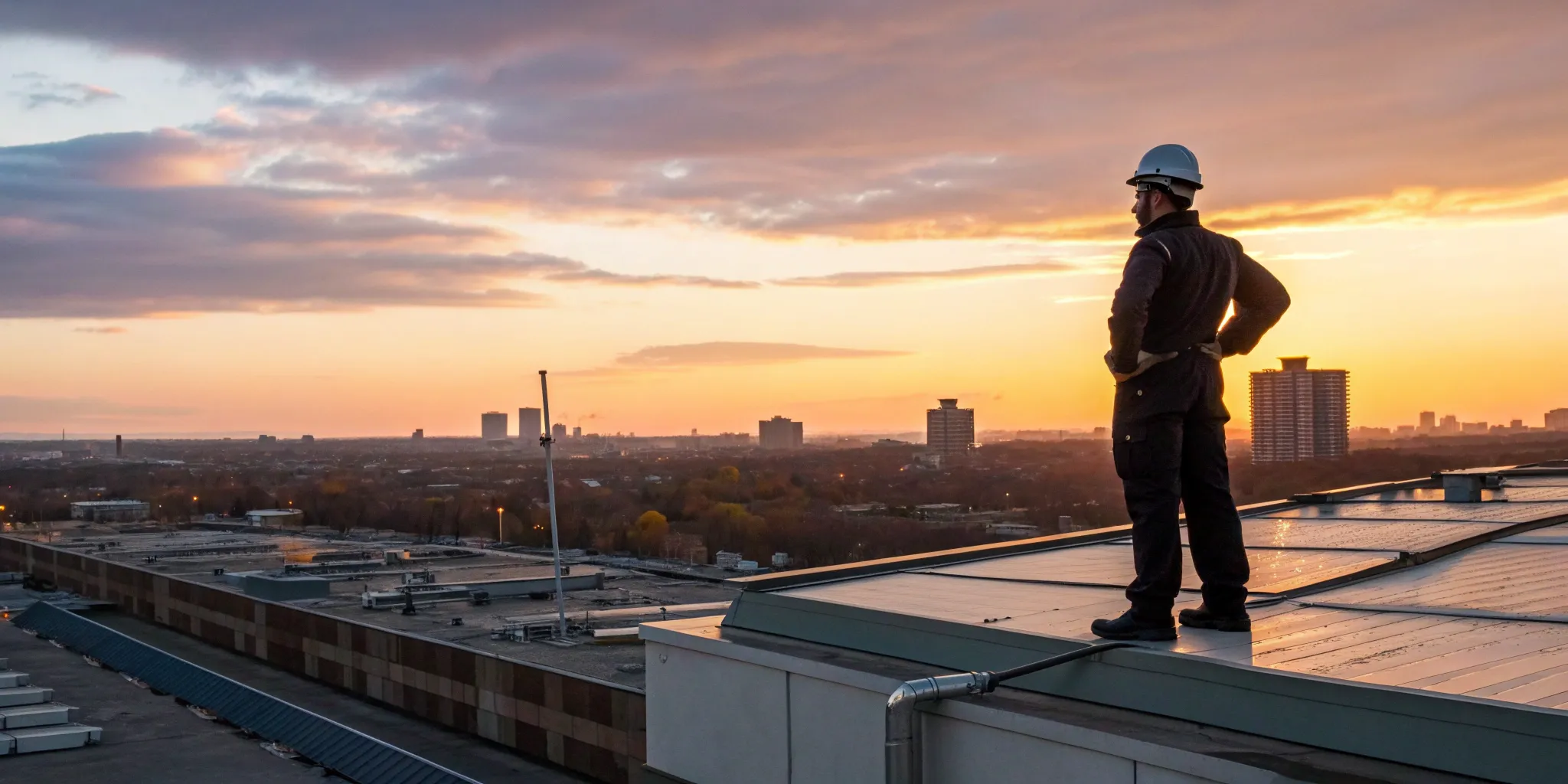
What commercial roof inspector training covers
A failed roof on a house is a repair bill. A failed roof over a warehouse is damaged inventory, an insurance claim and a shuttered operation. That gap is why commercial roof inspector training exists as its own discipline rather than a module bolted onto residential work.
Commercial roofs are usually low-slope or flat, which changes almost everything. Water does not run off, it drains, and drainage fails in ways a pitched roof never shows you. The training has to cover the membrane systems you will actually stand on, TPO, EPDM, PVC and modified bitumen, plus built-up and coated assemblies. It has to cover seams, terminations, curbs, drains, scuppers, ponding, and the mechanical equipment that gets installed on a roof and then serviced by people who are not roofers.
Whether you qualify
The bar is practical rather than academic. A degree helps nobody on a roof. Field time does.
Most people who succeed in this work arrive from roofing, general construction or claims adjusting. They already know how assemblies go together, which means they can recognize when one went together wrong. If you are coming in without that background, get roof time before you get a credential. Work alongside an experienced inspector. Take the jobs that put you on unfamiliar systems.
There is no federal license for roof inspectors. Your state may license contractors who perform inspections, or it may not, and cities sometimes add their own requirement. Call your state contractor licensing board before you enroll anywhere, so you know what the credential does and does not settle.
The NRCIA path
NRCIA has set the standard for roof inspection and certification since 1995. NRCIA does not inspect roofs and does not certify properties. Accredited members do both.
Each program is an annual membership and the training accreditation you earn.
- RoofGUARD™ earns the NRCIA Certified Roof Inspector (CRI) designation and authorizes the LeakFREE® inspection and certification work.
- ForensicGUARD™ is the flagship program. It earns the NRCIA Forensic Roof Inspector (FRI) designation for cause and origin and construction defect work, and it includes everything RoofGUARD authorizes.
- E3GUARD™ covers California SB 721 inspections of exterior elevated elements on multifamily rental property, with no prerequisite program.
If your target market is multifamily and commercial portfolios, look closely at E3GUARD. California’s SB 721 deadline for rental buildings of three or more units passed on January 1, 2026, and re-inspection runs every six years. SB 326, covering condominium and HOA associations, passed its deadline on January 1, 2025, with re-inspection every nine years. Both are now ongoing compliance cycles rather than one-time events, and property managers are looking for qualified people to run them.
What accreditation lets you issue
An accredited member performs a LeakFREE Check across five zones: interior, attic, exterior, perimeter and rooftop. The findings become a LeakFREE Roof Inspection Report. Where the roof meets the published criteria, the member can issue a LeakFREE Roof Certification, generated and registered through InspectionPLUS®. A certificate created outside that platform is not valid. LeakFREE is our federally registered trademark. Only NRCIA members can issue a LeakFREE certification.
Be precise with clients about what the certification is. It records that a specific roof, at a specific address, on a specific date, met the published criteria. It is issued by you, the individual who performed the inspection, never by your company. It is not insurance and not a service contract. The term is set by the findings, the slope, the materials and the condition, up to a maximum of ten years, and it is never stretched to close a deal.
The market is there. Across 6,460 member inspections, more than 66 percent of roofs either qualified for a LeakFREE certification or could be repaired to qualify.
Budgeting the enrollment
Count the whole thing before you commit. Tuition, exam fees, travel for any in-person session, safety equipment rated for the work, a camera you trust, annual dues, and the renewal cycle. Ask each program what renewal costs and how often, because that number repeats every year while tuition happens once. Ask about payment plans and group enrollment before you assume the sticker is the sticker.
The steps to enroll
- Confirm your state and city licensing requirements.
- Choose the Program that matches the work you intend to sell, and the Package that matches how much support you want.
- Put together your work history, including the roof systems you have hands-on time with.
- Complete the coursework, then sit the exam.
- Log your field experience.
- Set a calendar reminder for continuing education and renewal.
Getting work once you are accredited
Your credential opens the conversation. It does not fill the calendar. The people who route commercial inspection work are property managers, HOA boards, facility managers, commercial brokers, insurance adjusters and construction attorneys. Meet them on purpose.
- Get listed where clients look for accredited inspectors, and keep the listing current.
- Build a plain website that names your service area, your systems and your credential.
- Pick one professional network where your buyers already spend time, and post there consistently.
- Ask every satisfied property manager which peer of theirs has the same problem.
Referrals compound. Reputation is the asset you are actually building, and the credential is what makes it legible to someone who has never met you.
Start your accreditation. Review the RoofGUARD program.
LeakFREE®, Forensic ROOF®, Mr. RoofCheck®, InspectionPLUS®, Today’s Inspection… Tomorrow’s Protection®, and Got Leaks?® are registered trademarks of Field Gate FLP, used by permission. RoofGUARD™, ForensicGUARD™, DisasterGUARD™, E3GUARD™, and Think Like a Raindrop™ are trademarks of Field Gate FLP.