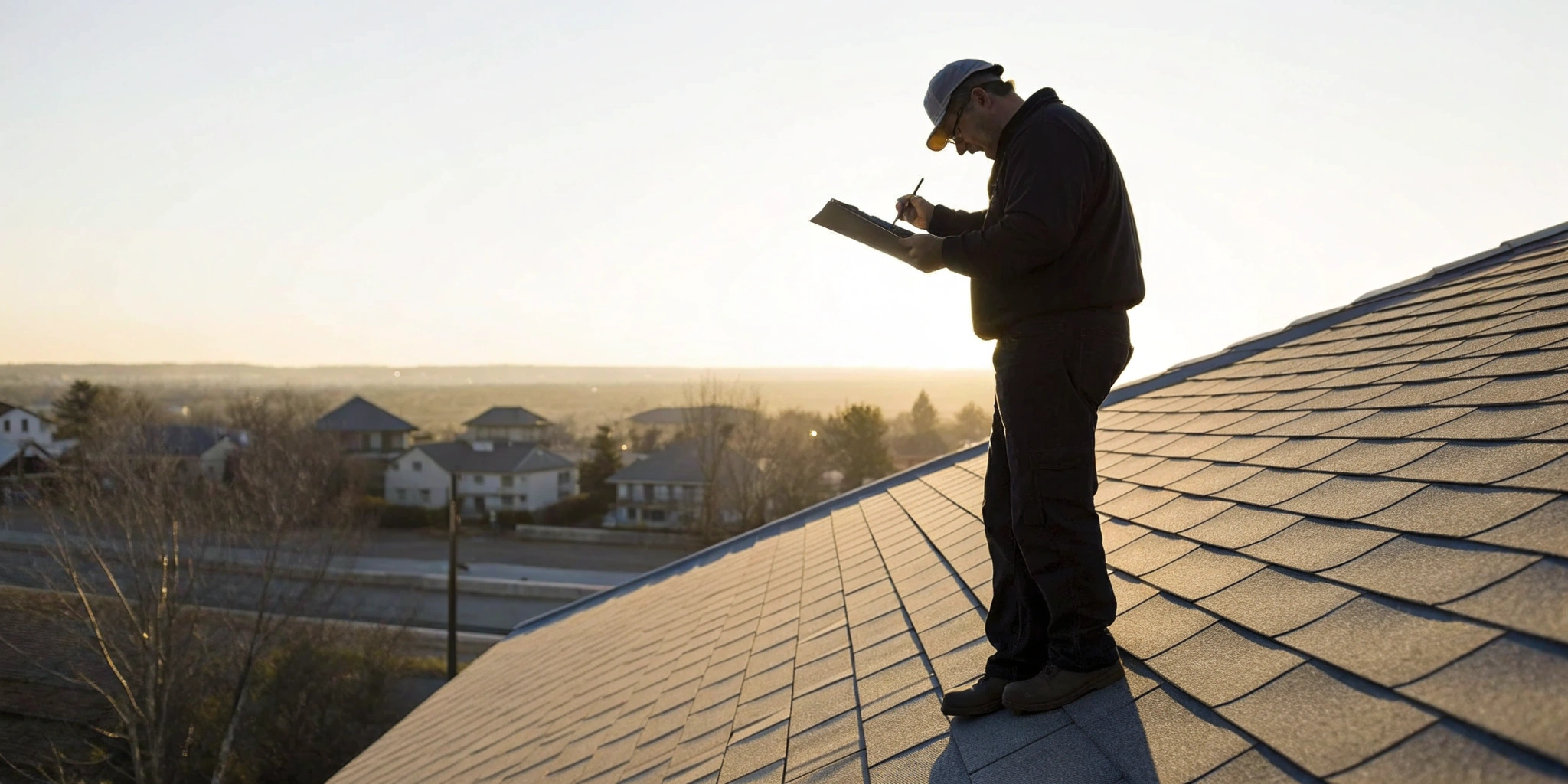
Why a roof damage inspection report template matters
The people who decide what happens next were not on the roof. An insurance adjuster, a buyer’s agent, an HOA treasurer, sometimes an attorney. They read the document. A roof damage inspection report template puts the same information in the same order on every job, so the finding survives the trip from the ladder to the file.
Consistency protects the inspector too. When every report follows one structure, a missing section is obvious before the report leaves your hands. When each report is improvised, the gap surfaces later, in a denied claim or a deposition.
What belongs in a roof damage report
Identification and conditions
Client name, property address, date of inspection, and the name of the individual who performed it. A person, not a company. Add the weather that day and any recent storm event with its date. That one line is what later connects visible damage to a specific event.
Roof description
Slope and configuration, covering material, approximate age, number of layers, and every penetration: chimneys, skylights, vents, curbs, solar arrays. A reader who understands the system understands why a given failure mode is expected. Record what you could not reach and why. An unreachable area is a finding. Saying nothing about it is exposure.
The damage log
“Damaged shingles” tells a reader nothing. Write the type of damage, its location, and its extent. Granule loss on the south slope, roughly 40 square feet. Three cracked tiles at the west valley. Separated counterflashing at the chimney, north side. Then rate each item so a non-roofer can triage it. Good, fair, poor works. So does immediate, near term, monitor. Pick one scale and use it on every job.
Photographs
Shoot wide, then medium, then close. The wide frame proves location. The close frame proves the defect. Annotate with an arrow or a circle. A close-up with no context is an argument waiting to happen. Where you measure something, put a tape or a coin in the shot.
Observation, conclusion, recommendation
Keep these three apart. Observation: staining on attic sheathing below the valley. Conclusion: water entry at the valley metal. Recommendation: open and reflash. Separating what you saw from what you concluded is what makes a report usable in a claim and defensible when someone challenges it.
Build the template around the five zones
NRCIA members work a LeakFREE® Check across five zones: interior, attic, exterior, perimeter, and rooftop. A damage report organized the same way is harder to argue with, because the reader can see the inspector looked below the roof as well as on top of it. Most leak evidence appears at the ceiling line and in the attic well before anything is visible from the ridge.
Mistakes that weaken a report
- Pricing inside the findings. Keep the assessment and the repair proposal as separate documents where you can. A report that reads as a sales piece loses weight with an adjuster.
- Absolute language. Describe what the roof showed on the date of the inspection. Do not predict future performance.
- Undated photos. Without a date and an address, an image proves very little.
- No signature, no credential line. The report should name the individual and the accreditation held.
- Recycled boilerplate that does not match the roof in the photographs. Editors and adjusters catch this quickly.
Where the report leads
A damage report is frequently the start of a repair path rather than the end of one. Across 6,460 member inspections nationwide, more than 66 percent of roofs either qualified for a LeakFREE® Roof Certification or could be repaired to qualify. Documenting the defect precisely is what makes that second path possible, because the repairing contractor knows exactly what to correct and the re-inspection has something specific to verify.
NRCIA members produce the LeakFREE® Roof Inspection Report and generate certificates through InspectionPLUS®. A certificate created outside that platform is not valid. LeakFREE® is our federally registered trademark, and only NRCIA members can issue a LeakFREE® certification. The certification records that a specific roof, at a specific address, on a specific date, met the published criteria. It is not insurance, and it is not a promise about future performance.
Standardize once, then stop rewriting it
Most inspectors already know what to look for. The gap is usually in how findings get recorded, and that gap costs jobs. Set the template, run every inspection through it, and let the document do the arguing. NRCIA trains and accredits members to one reporting standard, which is why a member report reads the same in Sacramento as it does in Tampa.
Review the RoofGUARD™ program and start accreditation
LeakFREE®, Forensic ROOF®, Mr. RoofCheck®, InspectionPLUS®, Today’s Inspection… Tomorrow’s Protection®, and Got Leaks?® are registered trademarks of Field Gate FLP, used by permission. RoofGUARD™, ForensicGUARD™, DisasterGUARD™, E3GUARD™, and Think Like a Raindrop™ are trademarks of Field Gate FLP.