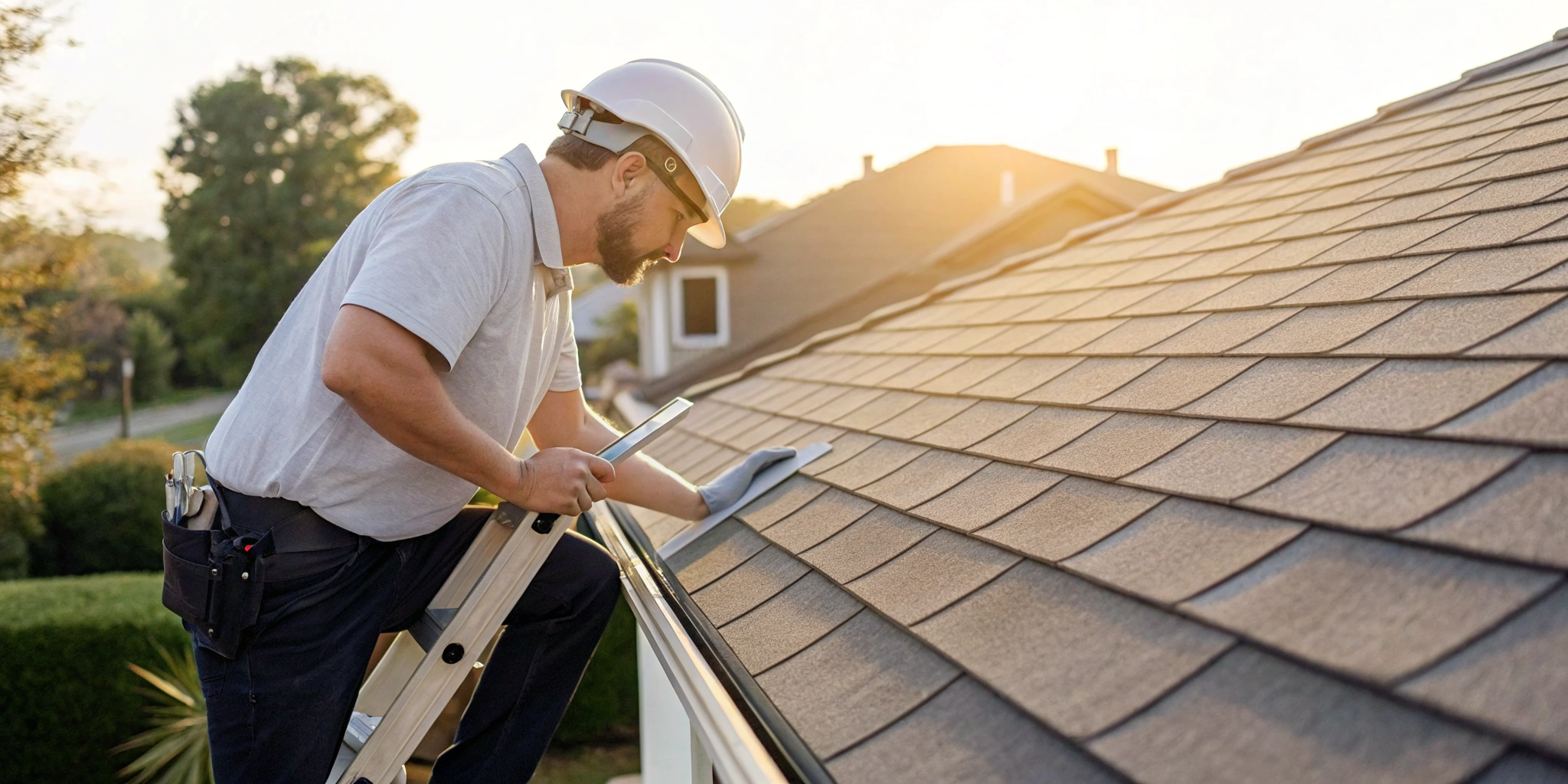
What a roof leak inspection service actually covers
A roof leak inspection service is a documented examination of the whole roofing system, not a look at the spot where the water showed up. Water travels. It enters at a failed flashing joint, runs along a rafter, soaks insulation for weeks, and finally stains a ceiling three rooms away. Chasing the stain finds the symptom. Examining the system finds the entry point.
Members trained through NRCIA’s RoofGUARD™ program work the LeakFREE® Check, which covers five zones in a set order: interior, attic, exterior, perimeter and rooftop. The order matters. Interior evidence tells the inspector where to look in the attic, attic evidence narrows the rooftop search, and the perimeter walk catches drainage problems that never appear from the ground.
By the time you see a stain, the damage is already paid for
A ceiling stain is a late signal. Before it forms, moisture has usually sat in the insulation and framing long enough to compress the insulation, feed mold and start softening the deck. Resealing a flashing joint is a small job. Replacing a section of rotted deck, remediating mold and repainting is not.
Roofs also fail quietly at predictable points: penetrations, valleys, transitions, terminations and anywhere two materials meet. Those are the places an inspection checks even when nothing looks wrong from the driveway.
What sets the price of a roof leak inspection service
Quotes vary widely, and the variation is usually legitimate. The factors that move the number:
- Size and layout. More roof planes, dormers and levels mean more time on the roof.
- Slope and access. Steep or fragile surfaces require fall protection and slower movement.
- Material. Tile and slate take longer to walk and read than asphalt shingle.
- Method. A documented visual examination costs less than one that adds infrared scanning, moisture metering or a controlled water test.
- Purpose. An inspection supporting a sale, a claim or a certification carries more documentation than a maintenance check.
- Region. Labor and insurance costs differ by market.
Be careful with a free inspection offered by a company that also sells roof replacements. The examination may be fine. The incentive is not neutral, and you have no way to tell the difference from the outside. Paying for an independent examination buys you a finding that does not depend on what the finder gets to sell you afterward.
The tools that find water you cannot see
Infrared scanning
Trapped moisture holds and releases heat differently from dry material. An infrared camera reads that difference across the roof surface and shows saturated areas as distinct thermal patterns. It works best on low-slope and flat roofs, where water spreads far from its entry point before it ever reaches a ceiling.
Moisture meters
Infrared shows a suspect area. A moisture meter confirms it, either through surface contact or with probes, and gives a reading that can be recorded and repeated. Scanning without metering produces a hunch. Together they produce evidence.
Controlled water testing
When the entry point stays hidden, an inspector can apply water to isolated sections in sequence while a second person watches inside. It is slow and methodical, and it identifies the actual breach rather than the general area.
When to schedule one
- After hail, high wind or any storm severe enough to move debris
- Every year once the roof passes twenty years of age
- Before listing a home, and during the inspection period when buying
- When a musty smell, peeling paint near the ceiling or a discolored ring appears
- Before a warranty maintenance requirement comes due
- After any repair performed by someone other than an NRCIA member, which triggers re-inspection of an existing LeakFREE® certification
How to choose the inspector
There is no federal license for roof inspectors. Anyone can print a card. That makes the credential you verify more important than the credential you are shown.
- Ask which accreditation and what it required. An NRCIA Certified Roof Inspector has completed the RoofGUARD™ program and works to published criteria.
- Ask for a sample report. Photographs with locations, moisture readings, a component-by-component condition record, and dated findings.
- Ask who pays them. An inspector who does not bid the repair has nothing riding on the outcome.
- Ask how the record is stored. NRCIA members generate and register reports through InspectionPLUS®, so the file exists independently of any one company.
What a LeakFREE® certification records
A LeakFREE® Roof Certification states that a specific roof, at a specific address, on a specific date, met the published LeakFREE® criteria after inspection. It is issued by the accredited individual who performed the work and generated through InspectionPLUS®. A certificate produced outside that system is not valid.
It is a dated record of condition against a written standard. It is not insurance, not a service contract, and not a promise that a roof will never leak. The term is set by the findings, the slope, the materials and the condition, up to a maximum of ten years, and the expiration is printed as a date. LeakFREE® is our federally registered trademark. Only NRCIA members can issue a LeakFREE® certification.
Across 6,460 member inspections nationwide, more than 66 percent of roofs either qualified for a LeakFREE® certification or could be repaired to qualify. Most roofs that worry their owners turn out to be fixable.
Find an accredited NRCIA inspector near you in the member directory and get the roof looked at before the ceiling tells you.
LeakFREE®, Forensic ROOF®, Mr. RoofCheck®, InspectionPLUS®, Today’s Inspection… Tomorrow’s Protection®, and Got Leaks?® are registered trademarks of Field Gate FLP, used by permission. RoofGUARD™, ForensicGUARD™, DisasterGUARD™, E3GUARD™, and Think Like a Raindrop™ are trademarks of Field Gate FLP.