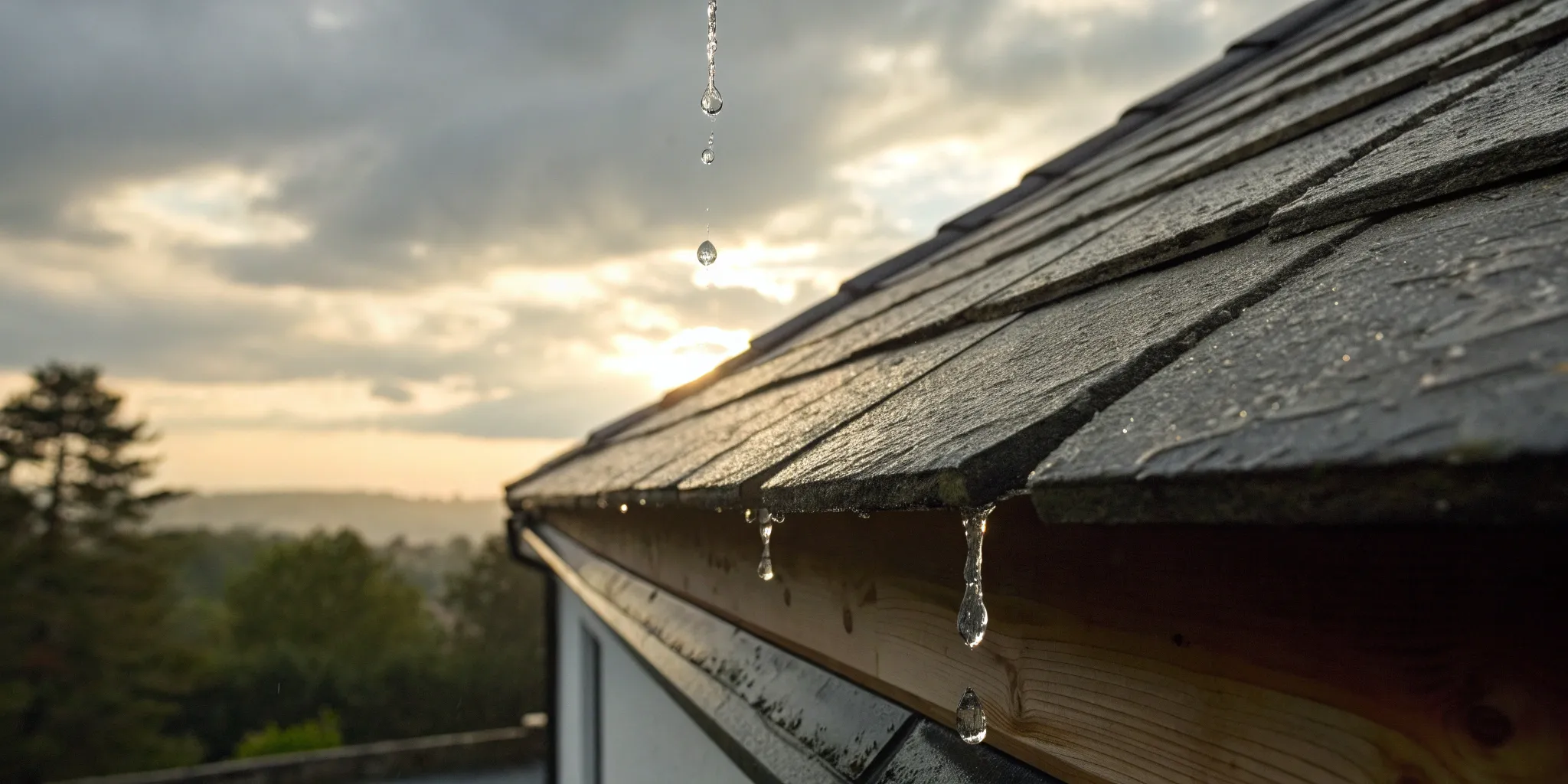
Find the source of a roof leak, not the stain
To find the source of a roof leak you have to stop looking at the ceiling. Water that gets past the covering travels. It runs down the underside of the deck, along a rafter, across a seam in the plywood, through insulation, and drops at whatever low point it reaches. The entry point can sit ten feet away and several feet higher than the drip.
Patch the ceiling and the water comes back. Trace the trail uphill and you get one repair instead of four.
Read the signals inside the house
Start with what the building is already telling you. On the top floor, look for discolored rings or streaks on ceilings and walls, paint that has begun to peel, drywall that looks swollen or soft. Use your nose as well. A persistent musty smell in a closet or an attic usually means moisture has been present long enough for mildew.
Note where each sign appears and how far it sits from the nearest exterior wall. That measurement becomes your reference point once you are in the attic.
Work the attic methodically
The attic is where evidence shows up before it reaches your ceiling. Go up on a dry day with a headlamp, safety glasses, a dust mask and gloves. Step on joists or decked areas only. A foot through the ceiling is a bad trade for a leak hunt.
- Kill the lights and look for daylight. Pinholes at fasteners, gaps at a ridge or a vent, light around a pipe boot. Mark anything you see.
- Turn the lights back on and read the wood. Dark staining, mineral trails, rusted nail shanks, mold on rafters or on the underside of the deck.
- Feel the insulation. Damp, matted or compressed batts sit under active or recent intrusion.
- Follow every stain to its highest point. Water runs down, so the top of the discoloration is nearest the entry.
- Give penetrations extra time. Vents, plumbing stacks, chimneys and skylights are where most leaks start.
Photograph everything as you go and note locations against a fixed landmark: the third rafter from the gable, two feet left of the bath vent. Vague notes are useless a week later.
Check the exterior from the safest position available
Much of an exterior check can happen with both feet on the ground and a pair of binoculars. Walk the perimeter and look for shingles that are missing, lifted, curled or cracked. Look in the gutters for a heavy accumulation of granules, which points to an aging surface. Look at the siding below the roofline for staining.
If you use a ladder, set it on flat ground, use one with slip resistant feet, keep the base one foot out for every four feet of height, and have someone hold it. Maintain three points of contact. Do not overreach and do not stand on the top rungs.
Stay off the roof entirely if it is wet, icy, windy, steep or more than a single story. There is no leak worth a fall, and a trained inspector can reach the same places with the right equipment.
Run a controlled water test
When the visual search comes up empty, recreate the conditions. A water test is slow, and it works.
You need two people. One stays inside near the known evidence with a phone and a flashlight. The other works outside with a garden hose on a gentle flow, no pressure nozzle.
- Begin at the lowest part of the slope below the suspected area.
- Soak one small section for several minutes, then stop and wait. Water needs time to travel.
- If nothing appears inside, move up one section and repeat.
- The moment the spotter sees a drip, stop. The section you were wetting contains the entry.
From there, narrow it. Have the spotter call out the nearest landmark inside, a vent pipe or a window head, so you can line up the same feature outside. Isolating one course of shingles or one flashing joint is often the difference between a fifty dollar fix and a full slope replacement.
Common mistakes that waste the search
- Assuming the leak is directly above the drip. It is the single most common reason a repair fails.
- Sealing a guess. A tube of caulk over a suspected spot can trap moisture and hide the real path for another season.
- Testing during rain. Everything is wet, nothing is diagnostic, and the roof is dangerous.
- Skipping documentation. Photos with dates carry weight with a carrier, a contractor and a future buyer.
When to bring in an accredited inspector
Some leaks resist every method above. Water can enter at a wall detail, a window head or a failed sidewall flashing and present exactly like a roof leak. Multiple stains, a sagging ceiling, spongy decking or visible mold all mean the problem has moved past detection and into assessment.
An NRCIA Certified Roof Inspector is trained to a national standard and performs a LeakFREE® Check across five zones: interior, attic, exterior, perimeter and rooftop. Members use moisture meters and thermal imaging to locate water the eye cannot see, and findings are documented in a LeakFREE® Roof Inspection Report you can hand to a contractor, an agent or a claims adjuster. There is no federal license for roof inspectors, so the accreditation behind the person on your roof is worth confirming.
Where a roof meets the published criteria, that member can issue a LeakFREE® Roof Certification through InspectionPLUS®. It records that a specific roof at a specific address met the criteria on a specific date, with a term set by the findings, the slope, the materials and the condition, to a maximum of ten years. It is not insurance and it is not a service contract. LeakFREE® is our federally registered trademark. Only NRCIA members can issue a LeakFREE® certification.
Find an accredited inspector near you in the NRCIA member directory.
LeakFREE®, Forensic ROOF®, Mr. RoofCheck®, InspectionPLUS®, Today’s Inspection… Tomorrow’s Protection®, and Got Leaks?® are registered trademarks of Field Gate FLP, used by permission. RoofGUARD™, ForensicGUARD™, DisasterGUARD™, E3GUARD™, and Think Like a Raindrop™ are trademarks of Field Gate FLP.