Before anyone goes up
A commercial roof inspection checklist is worth nothing if the person holding it gets hurt. Settle the safety questions before the ladder comes off the truck.
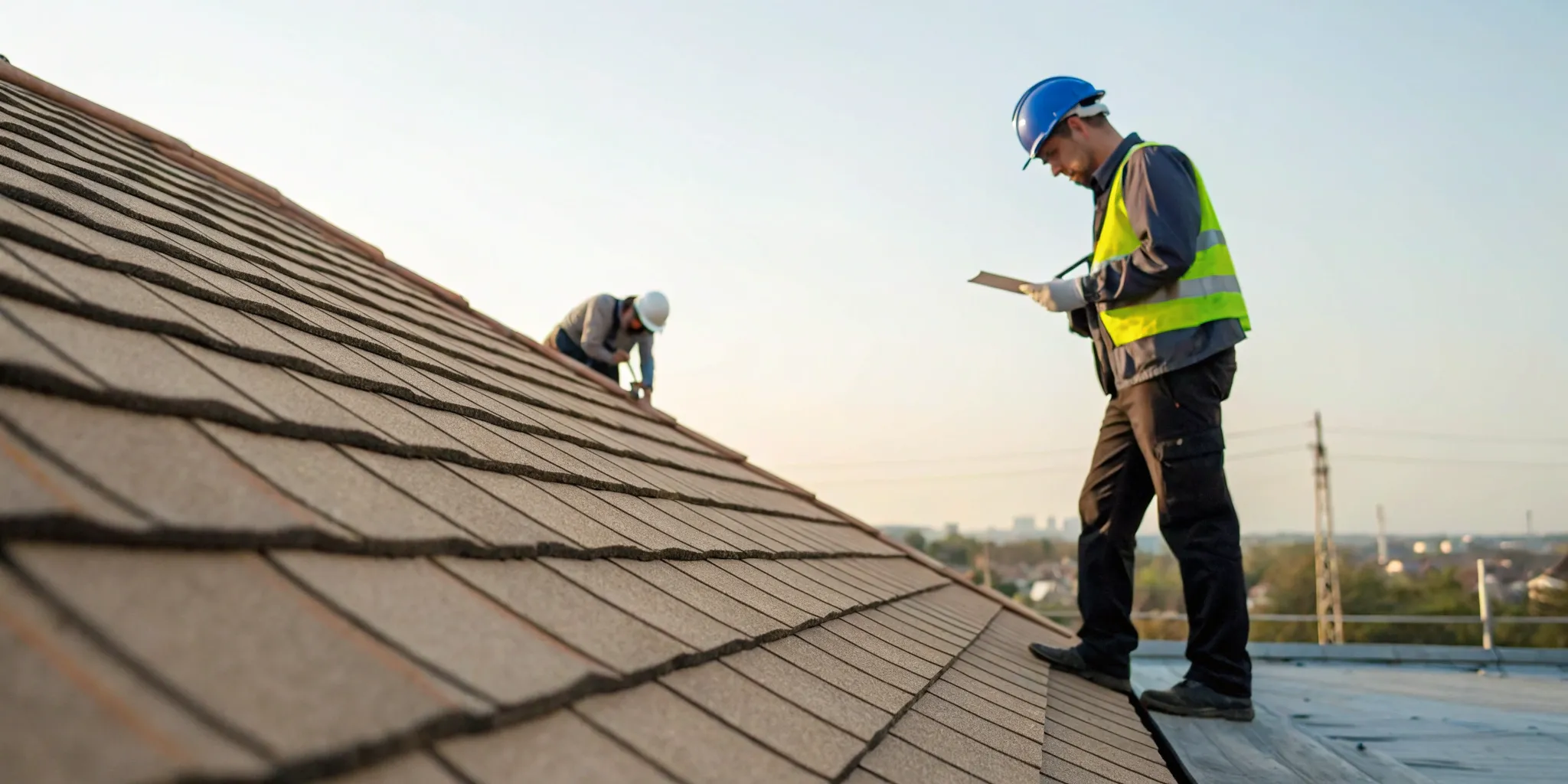
OSHA requires fall protection for construction work at heights of six feet or more above a lower level. That means guardrails, a personal fall arrest system, or a safety net system, plus a hard hat, eye protection, gloves and non-slip footwear. Secure the ladder on stable ground. Check that roof hatches and permanent ladders are sound before trusting them. Stay off the roof in rain, ice, snow or high wind, and postpone rather than improvise.
If the roof is steep, multi-level, or crowded with equipment, that is the point to bring in a trained professional instead of walking it yourself.
The commercial roof inspection checklist
Work the same sequence every time. Consistency is what turns a set of notes into a usable history of the building.
Start inside
- Ceilings and wall tops on the top floor: stains, discoloration, peeling paint, bubbling.
- Musty odor or visible mold, especially after heavy rain.
- Daylight visible through the deck in unfinished areas.
- Insulation that feels damp or compressed.
Roof surface and materials
- Membrane: splits, blisters, punctures, open or lifting seams, shrinkage at the perimeter.
- Metal: rust, loose or backed-out fasteners, oil canning, failed sealant at laps.
- Shingle or tile sections: cracked, curled, slipped or missing units, granule loss.
- Soft or spongy spots underfoot, which usually mean wet insulation below.
- Foot traffic damage near equipment and walkways.
Drainage
- Internal drains, scuppers, gutters and downspouts clear of debris.
- Strainers in place and intact.
- Ponding water that remains more than 48 hours after rain.
- Evidence of past ponding: rust rings, algae, concentrated silt deposits.
- Low spots, crushed insulation and settled areas that hold water.
Flashing and penetrations
- Base and counter flashing at parapets and walls: gaps, open laps, failed sealant.
- Curbs and boots at HVAC units, exhaust fans, vents, pipes and conduit.
- Skylights: cracked glazing, failed gaskets, deteriorated curbs.
- Expansion joints and roof-to-wall transitions.
- Abandoned penetrations that were never properly closed.
Access and safety features
- Permanent ladders, hatches and walkway pads secure and in serviceable condition.
- Guardrails and anchor points stable and inspected.
- Clearance around equipment for safe service access.
Documentation
- Wide shots of each roof section, then close-ups of every defect.
- Date on every photograph, and a location note for each finding.
- Same form, same order, every visit, so year-over-year comparison is possible.
How often to inspect
Twice a year is the working standard for commercial roofs: once in spring to assess winter damage, once in fall to clear debris and prepare for the wet season. The Hanover Insurance Group recommends at least an annual inspection to catch material and drainage problems before they become leaks.
Add an inspection after any severe weather event, whatever the calendar says. Add one after any trade works on the roof, because a solar crew, an HVAC technician and a satellite installer all create penetrations.
Most commercial roofing warranties and property policies require documented maintenance. Undocumented maintenance and no maintenance look identical during a claim.
When to bring in an accredited inspector
A property manager can run the checklist above and manage the building better for it. Some situations call for a professional assessment instead.
- An insurance claim, where the report has to hold up under review.
- A warranty question, where the provider requires a qualified assessment.
- A purchase, sale or refinance, where a lender or buyer wants documented condition.
- Any leak whose source you cannot locate.
- A roof that cannot be walked safely.
There is no federal license for roof inspectors, so the credential to verify is the accreditation. NRCIA trains and accredits members and maintains the member directory. Members work through five zones: interior, attic or plenum, exterior, perimeter and rooftop. If the roof meets the published criteria, the accredited member who performed the inspection can issue a LeakFREE® Roof Certification, generated and registered through InspectionPLUS®, with a term reflecting the findings, the slope, the materials and the condition, to a maximum of ten years.
That certification records condition on a date. It is not insurance, and it does not promise a roof will never leak. LeakFREE® is our federally registered trademark, and only NRCIA members can issue a LeakFREE® certification.
California buildings: the elevated elements are separate
If your portfolio includes multifamily property in California, the balconies, walkways and stairs carry their own inspection requirements. SB 721 applies to rental buildings with three or more units, and its initial deadline of January 1, 2026 has passed, with re-inspection every six years. SB 326 applies to condominium and HOA associations, its deadline of January 1, 2025 has passed, and re-inspection runs every nine years. Penalties are commonly cited at 100 to 500 dollars per day, along with a possible building safety lien. NRCIA accredits members for this work through E3GUARD™, with state tracks for CA-SB721 and CA-SB326.
Find an accredited NRCIA inspector near you. Search the NRCIA member directory and schedule your next commercial roof inspection.
LeakFREE®, Forensic ROOF®, Mr. RoofCheck®, InspectionPLUS®, Today’s Inspection… Tomorrow’s Protection®, and Got Leaks?® are registered trademarks of Field Gate FLP, used by permission. RoofGUARD™, ForensicGUARD™, DisasterGUARD™, E3GUARD™, and Think Like a Raindrop™ are trademarks of Field Gate FLP.