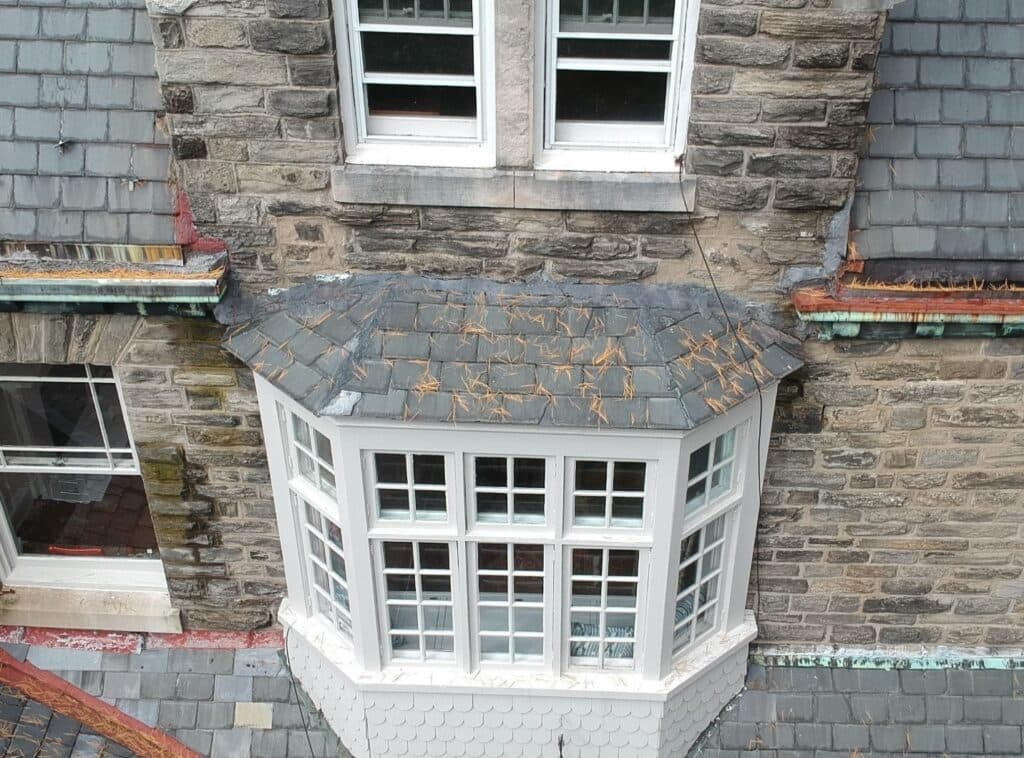
Where a drone roof inspection helps
A drone roof inspection puts the whole roof in one frame. One oblique pass can show corroded flashing, worn gutters, piecemeal patching, replaced slates and a bay peak repaired with roofing cement, all before you set a ladder. A skilled pilot can then drop in for the detail shots that carry a report.
Drones earn their place when a roof is too steep, too tall, too fragile or too far gone to walk. They shorten the time on site and they keep an inspector off a surface that should not hold weight. They do not replace walking a roof when walking it is safe and appropriate. Treat the aircraft as one more instrument, alongside the moisture meter and the camera.
Equipment matters less than most people expect. Prosumer aircraft carry cameras roughly comparable to a good phone. Higher-end models add larger sensors, optical zoom and infrared. What separates a usable inspection flight from a liability is not the airframe. It is flying legally.
Paid work means you need a Part 107 certificate
The Federal Aviation Administration treats drone flight for compensation as commercial operation under Part 107. If a drone image ends up in a paid inspection report, that is commercial use. So is posting drone footage to promote your business. There is no gray zone worth testing here, and there is no state or local workaround: Part 107 is federal.
The certificate is a Remote Pilot Certificate. Most people call it a Part 107 license. Whatever you call it, you carry proof of it during every flight.
The four steps, in order
- Create an IACRA profile. The Integrated Airman Certification and Rating Application lives at iacra.faa.gov. It is the digital folder that holds your ratings and registrations. Setting it up triggers security vetting and assigns you an FAA Tracking Number. Write the FTN down. It follows you for the rest of your flying career.
- Study, then take the knowledge test. The exam runs two hours and covers 60 questions on airspace classification, weather, aircraft loading and performance, emergency procedures, radio phraseology, airport operations, preflight checks, night operations, crew resource management, and the physiological effects of drugs and alcohol. You schedule it in advance and sit it in person at an FAA-approved testing center. There is a fee for every attempt.
- Apply inside IACRA. Passing the test does not issue the certificate. Results post to your IACRA file in roughly 48 hours, and you then submit a separate application using those results. People miss this step constantly and wonder why nothing arrived.
- Print the temporary, wait for the card. A temporary certificate is available online right away. The permanent airman card arrives by mail a few weeks later.
Paid prep courses exist, in person and online, and plenty of pilots pass on free video study plus a test-prep book with chapter quizzes and practice exams. Whichever route you take, review every question you miss and the topic it came from before you move on. Then keep sitting practice exams until you clear a comfortable margin. After you are certified, recurrent training comes due every 24 calendar months and the FAA hosts it free online.
Knowing your airspace
The core limits are simple to state and easy to break. Keep the aircraft within visual line of sight. Stay at or below 400 feet above ground level. Night flight is permitted for certificated pilots who have completed the updated training and whose aircraft carries anti-collision lighting visible for three statute miles.
Airspace is where inspectors get caught. Uncontrolled airspace still carries the rules. Controlled airspace, which surrounds airports and wraps much of the urban and suburban work you actually get hired for, requires authorization before you fly. Look at an aviation sectional over any metropolitan area and the complication is obvious.
The Low Altitude Authorization and Notification Capability, LAANC, makes this workable. Approved service providers return near real-time authorization, usually within minutes. You log the location, date, time, aircraft, altitude and duration, and the approval comes back with notes, relevant Notices to Air Missions and a short weather picture. The FAA publishes the current list of approved LAANC providers, and that list changes, so check it rather than relying on an app a colleague mentioned two years ago.
Request authorization at least a day ahead. Near an airport or inside a restricted grid, your approved ceiling can come back at zero feet. Better to learn that the night before than from the driveway. Temporary restrictions also appear over stadiums, public events and VIP movements, so read the notices for the day you fly.
How this fits the inspection
Aerial imagery documents the rooftop zone. It does not replace the other four. An NRCIA member working a LeakFREE® Check still walks the interior, the attic, the exterior and the perimeter, because the evidence that predicts a leak often sits under the deck rather than on top of it. Think Like a Raindrop™ means following water to where it enters, not photographing where it lands.
Used that way, a drone strengthens the file: wide context images, close detail, consistent angles across a portfolio, and a record you can hand an owner or an adjuster. Used as a substitute for the full multi-zone process, it produces a thinner report than the situation deserves.
NRCIA members should check the member portal for current education partner discounts before paying full price for drone training.
Add the credential, then add the accreditation
A Part 107 certificate proves you can fly legally. Accreditation proves you can inspect to a published standard. Roofing professionals who hold both put a stronger document in front of clients.
Join NRCIA and start your accreditation at /join-nrcia/.
LeakFREE®, Forensic ROOF®, Mr. RoofCheck®, InspectionPLUS®, Today’s Inspection… Tomorrow’s Protection®, and Got Leaks?® are registered trademarks of Field Gate FLP, used by permission. RoofGUARD™, ForensicGUARD™, DisasterGUARD™, E3GUARD™, and Think Like a Raindrop™ are trademarks of Field Gate FLP.