Owners are either proactive or reactive
Most property owners are reactive about the roof. Time and budget push it down the list, and in much of the country rain is seasonal, so a roof stays out of sight until it announces itself through a ceiling. By then the small defect that could have been documented for a few hundred dollars has become a claim, a mold question and a tenant complaint. Comprehensive roofing inspections exist to move owners off that pattern.
The proactive group is growing, and the requests come from predictable places:
- Residential and commercial owners in escrow
- Owners establishing a cause of loss for an insurance claim
- Buyers shopping property insurance or trying to secure a loan
- Owners who want to know what they own
That last group is the opportunity. They want to be informed and they have no framework for it. A roof has fewer parts than most people assume, but almost no owner can name them. Your job is to educate, document and let the owner decide.
What comprehensive roofing inspections actually cover
Two things get called a roof inspection in the market and they are not the same product.
The no-charge estimate visit is a sales call. It looks at the rooftop, skips the interior, the attic and the perimeter, and produces an estimate on company letterhead. Scope grows once work begins, because the conditions that drive scope were never examined. Nothing about that is dishonest. It is simply a bid, and it should be described to the client as a bid.
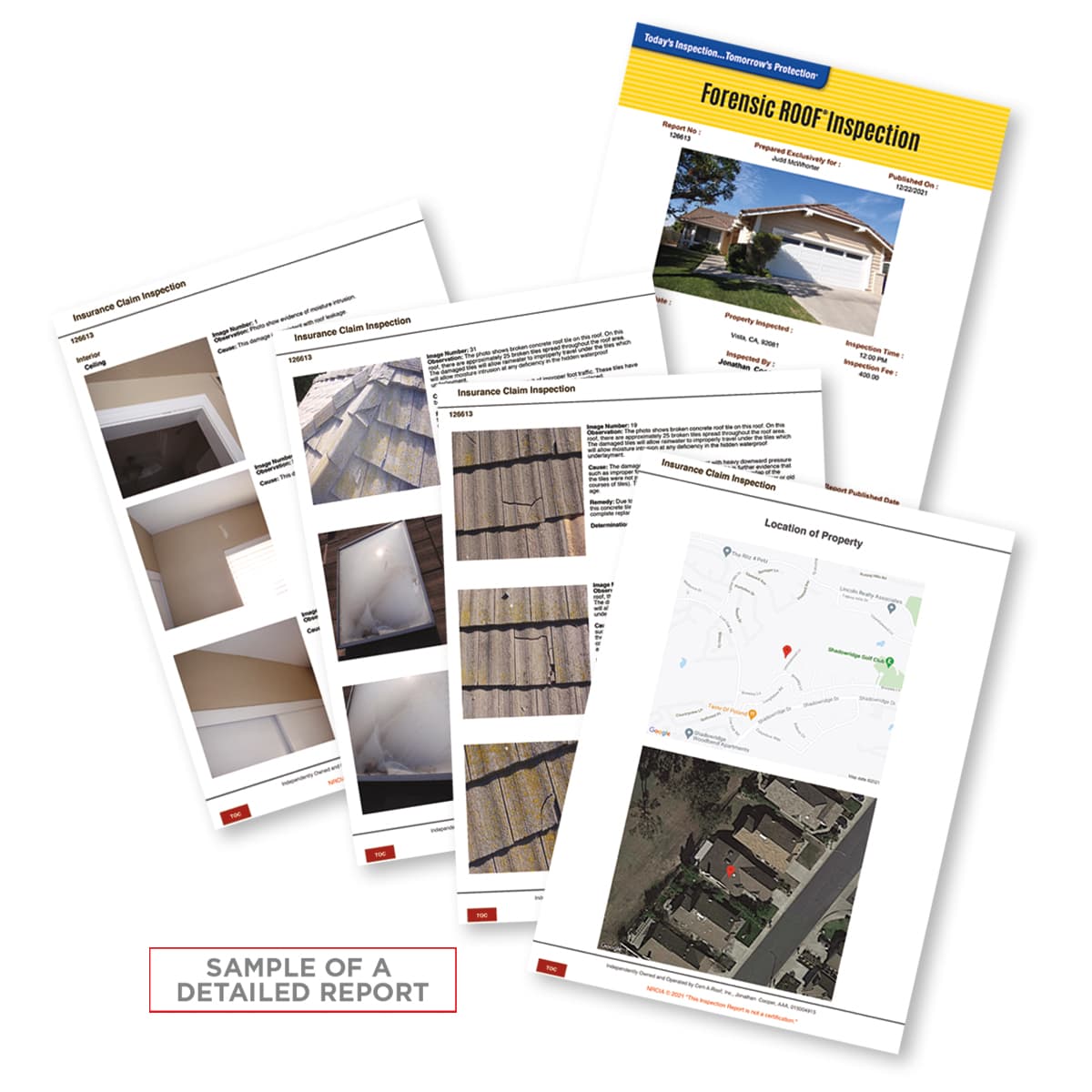
The paid inspection is a professional service. It works from the inside out, covers the full system, and produces a written report with photographs and a proposal package. Hidden components decide most outcomes: waterproof underlayment, mechanical fasteners, deck condition, staining that shows a leak path months before a drop reaches the ceiling. None of that reads from the rooftop.
Price follows the work, not a rate card. Roof size, slope, complexity, region, certification term and the purpose of the inspection all move it. Set your own fee for your own market.
The five zones
An NRCIA Certified Roof Inspector performs a LeakFREE® Check across five zones: interior, attic, exterior, perimeter and rooftop. The zones are the standard. Skipping one is how a report becomes an opinion.
Inside each zone the inspector answers three questions:
- Is the roof leaking now?
- Is the roof likely to leak?
- If a leak develops within the certification term, can this system be repaired?
Answer those three honestly and the report writes itself. Where trauma is not visible at the leak location, an exploratory inspection may be needed. That is a separate service with its own scope and its own fee, and it should be quoted as one. Leave no trace otherwise. An inspection that damages a roof is a liability event.
Across 6,460 member inspections nationwide, more than 66 percent of roofs either qualified for a LeakFREE® Roof Certification or could be repaired to qualify. The certification term is set by the findings, the slope, the materials and the condition, up to a maximum of ten years, and it is never stretched to win a sale.
The report is the product
Photographs are the building block. A photo-centric LeakFREE® Roof Inspection Report should tell an owner three things about every finding:
- What you observed and what happens if it goes uncorrected
- Why it is there: deferred maintenance, workmanship defect, normal wear and tear, storm damage
- How it gets corrected, repair or replacement
A report built that way survives scrutiny. The owner can see how you reached your conclusion, which does more for conversion than any pitch. It also holds up later, when a re-inspection is requested, when a carrier asks how the damage occurred, or when someone else’s repair invalidates the certification and the file has to explain the sequence.
Certificates are generated and registered through InspectionPLUS®. A certificate produced outside the platform is not valid, and it is issued by the accredited individual who performed the inspection, never by the company name on the truck.
Service comes before the sale
Roofing is a service business. Think Like a Raindrop™ is the discipline that keeps it honest: water finds the weakness, so follow the water rather than the sales script. Everything else is repeatable.
- Serve before you sell
- Work all five zones, every time
- Inspect the whole system, not the visible part of it
- Evaluate, educate, document
- Take photographs an owner can understand without you in the room
Adding an inspection service line looks harder than it is. The process is short, the standard is published, and the accreditation is what tells a client your report means something.
Review the RoofGUARD™ program and start accreditation at /programs/roofguard/.
LeakFREE®, Forensic ROOF®, Mr. RoofCheck®, InspectionPLUS®, Today’s Inspection… Tomorrow’s Protection®, and Got Leaks?® are registered trademarks of Field Gate FLP, used by permission. RoofGUARD™, ForensicGUARD™, DisasterGUARD™, E3GUARD™, and Think Like a Raindrop™ are trademarks of Field Gate FLP.